Strategic Integration Across Modern Military Operations Logistics And Contemporary Defense Technology Systems

September 16, 2026 · 11 reads
Introduction
Modern defense environments are experiencing rapid structural shifts driven by technological disruption, shifting geopolitical realities, and multi-layered organizational challenges. Contemporary defense systems involve far more than frontline personnel and hardware, requiring a rigorous fusion of long-term planning, sustainable supply chains, integrated networks, and sound structural command. Mastering this field demands an appreciation of how military strategy, operational planning, logistics, command and control systems, emerging technologies, military history, organizational design, multidomain operations, and intelligence, surveillance, and reconnaissance operate as an interconnected whole. The educational platform WarOpsX.com exists to demystify these foundational defense subjects through structured, accessible, and high-level analytical resources designed for independent learners worldwide.
What Is WarOpsX.Com?
WarOpsX.com is an open, independent educational resource designed to deliver structured, analytical knowledge on defense studies, organizational architecture, operational planning, and national security concepts. Built specifically for students, researchers, policy analysts, defense enthusiasts, and institutional learners, the platform emphasizes systems-level thinking over isolated hardware specifications. It deliberately avoids actionable combat tactics, tactical instructions, and weapon-handling guidelines, focusing instead on institutional readiness, inter-agency coordination, command architectures, and strategic decision frameworks. By presenting defense as an interconnected ecosystem, the platform allows learners to examine how strategic objectives translate into operational reality across complex multi-theater security environments.
What Does WarOpsX.Com Cover?
The curriculum across WarOpsX.com spans ten foundational pillars of modern strategic knowledge: Military Strategy, Defense Studies, Military Operations, Military Logistics, Command and Control Systems, Defense Technology, Military History, Military Organizational Structure, Multidomain Operations, and Intelligence, Surveillance, and Reconnaissance. Rather than examining these concepts as disconnected silos, the platform clarifies how high-level doctrine shapes field readiness, resource distribution, network infrastructure, and cross-domain operational success. Learners are guided through the theoretical, structural, and historical layers that define modern defense organizations, developing the foundational literacy required to analyze contemporary security dilemmas, organizational restructuring, and technological transformations with clarity and analytical confidence.
Military Strategy
Military strategy is the art and science of coordinating national resources, institutional capabilities, and diplomatic instruments to achieve primary political objectives set by civilian leadership. While battlefield tactics focus on the immediate physical execution of specific engagements, strategy addresses long-term preparedness, risk management, regional deterrence, and large-scale resource allocation across years or decades. A classic strategic initiative might involve establishing persistent forward bases or diplomatic pacts to discourage an adversary from initiating conflict, whereas a tactical move simply dictates local movement during an active encounter. Understanding strategic principles enables defense researchers to analyze how sovereign states balance economic constraints, geographic realities, and institutional strengths to maintain security against emerging threats.
Defense Studies
Defense studies is an interdisciplinary academic domain combining political science, international relations, macroeconomics, public policy, military history, geography, and organizational sociology. Instead of merely listing weapon specifications or cataloging vehicle inventories, defense studies investigates the broader political imperatives, resource constraints, and diplomatic frameworks that govern how defense institutions are constructed and deployed. Students in this discipline evaluate civil-military relations, defense procurement budgets, industrial base sustainability, and public accountability frameworks to understand security policy holistically. This multidisciplinary perspective prevents analytical short-sightedness, allowing researchers to perceive defense organizations as instruments of national policy that must continually justify their economic, social, and geopolitical resource footprint.
Military Operations
Military operations constitute the essential operational bridge connecting high-level national strategy with actual tactical activities conducted across assigned operational theaters. At this intermediate tier, operational planning coordinates joint force elements, manages multi-theater supply lines, establishes staging timelines, and ensures operational readiness before any active missions commence. Operational art focuses heavily on theater geometry, sequencing complex joint maneuvers, synchronizing logistics, and managing systemic friction without drifting down into granular, tactical combat instructions. By studying operational concepts, learners understand how defense organizations translate abstract strategic directives into synchronized campaigns, balancing sustainment demands, troop rotation schedules, and intelligence feeds across massive geographic areas under fluid conditions.
Military Logistics
Logistics is the operational lifeblood of any defense enterprise, determining the functional limits of deployability, sustainment, operational endurance, and institutional readiness across every theater. The discipline encompasses supply chain resilience, multimodal transportation, fleet maintenance, munitions distribution, spare parts inventorying, airfield infrastructure, and deployed medical care. A stark historical lesson occurred during World War II in North Africa, where Axis mechanized formations were repeatedly halted not by enemy fire, but because extended supply lines through Tripoli ran completely dry of petroleum and spare parts. This reality proves that operational maneuvers cannot outrun logistical realities; without resilient depots, mechanical repair pipelines, and distribution networks, even the most technologically advanced formations experience rapid operational failure.
Command and Control Systems
Command and control systems encompass the organizational authority, procedural frameworks, communication networks, and personnel structures used to direct, coordinate, and supervise assigned forces. These systems operate through a continuous conceptual loop: raw information is collected, processed into operational intelligence, presented for strategic decision-making, issued as formal direction, executed across units, and assessed via immediate feedback. Successful command depends equally on resilient data links and sound organizational architecture, ensuring decision-makers preserve real-time situational awareness during disruptions. When modern networks fail or undergo cyber degradation, clear chains of command, defined operational procedures, and distributed mission command paradigms allow subordinate units to maintain operational momentum toward broader organizational objectives.
Defense Technology
Emerging defense technology transforms modern defense organizations through autonomous platforms, artificial intelligence, multi-spectral sensor arrays, secure satellite constellations, synthetic training simulations, and resilient cyber infrastructure. However, advanced technology cannot function as a standalone cure for flawed organizational thinking, unclear institutional objectives, or poor inter-service cooperation. High-end platforms require robust cyber resilience, rigorous human oversight, high-quality data governance, routine mechanical maintenance, and interoperability protocols to avoid catastrophic failure under electronic warfare conditions. Analysts must evaluate emerging technology as an integrated sub-component of a wider operational architecture, examining how digital tools enhance decision velocity and operational awareness rather than assuming automated platforms replace institutional discipline.
Military History
Military history offers learners an empirical laboratory of past strategic successes, logistical failures, technological transitions, and institutional adaptations across varying geographic and political landscapes. Rather than memorizing chronological battle dates, modern researchers analyze historical case studies to evaluate how past leadership responded to resource constraints, deceptive intelligence, communication breakdowns, and rapid technological shifts. Studying historical campaigns illuminates how institutional doctrines evolved, why specific organizational structures failed under operational stress, and how geographic realities have shaped security decisions for centuries. This analytical approach equips students with the contextual foundation required to evaluate modern defense debates, recognizing recurring structural challenges beneath modern technical terminology.
Military Organizational Structure
Military organizational structure establishes the formal hierarchy, command relationships, reporting channels, and administrative frameworks that govern armed services, regional commands, and joint operational forces. A well-defined chain of command ensures operational accountability, swift information routing, and synchronized resource distribution from joint headquarters down through operational formations and administrative detachments. Without organizational clarity, large-scale institutions experience duplicated efforts, blurred jurisdictional authorities, communication latency, and delayed strategic decision cycles. By studying structural models, joint commands, and inter-service divisions, learners discover how institutional design choices determine how effectively an armed force executes operational directives, integrates new branch capabilities, and adapts to evolving multi-theater requirements.
Multidomain Operations
Multidomain operations represent the synchronized integration of military capabilities across five interdependent operational arenas: land, maritime, air, space, and cyberspace, alongside the broader information environment. In contemporary operational environments, activities conducted in orbit or via digital networks directly alter physical maneuver spaces on land or sea, creating deep functional dependencies across all operational domains. For instance, ground-based air defenses secure maritime air corridors, while orbital communications constellations and cyber networks route the targeting data necessary to coordinate joint defensive deployments. Studying multidomain operations allows defense analysts to examine operational balance and systemic vulnerabilities, demonstrating how modern operations succeed through continuous cross-domain collaboration rather than single-service actions.
Intelligence, Surveillance and Reconnaissance
Intelligence, Surveillance, and Reconnaissance (ISR) comprises the integrated cycle of gathering, processing, evaluating, and disseminating operational information to provide leaders with actionable situational awareness. Reconnaissance represents focused, mission-driven scouting; surveillance provides persistent, ongoing observation of selected zones; and intelligence converts that raw data into analyzed operational assessments. This process moves through a disciplined cycle: collection, processing, analysis, assessment, and executive decision support, allowing leadership to manage friction and uncertainty responsibly. Rigorous ISR education emphasizes information verification, analytical bias mitigation, and data integrity, illustrating how reliable intelligence feeds prevent operational surprises, guide resource deployments, and minimize collateral risks during high-stakes strategic decision-making.
How Military Strategy, Operations, Logistics and Technology Connect
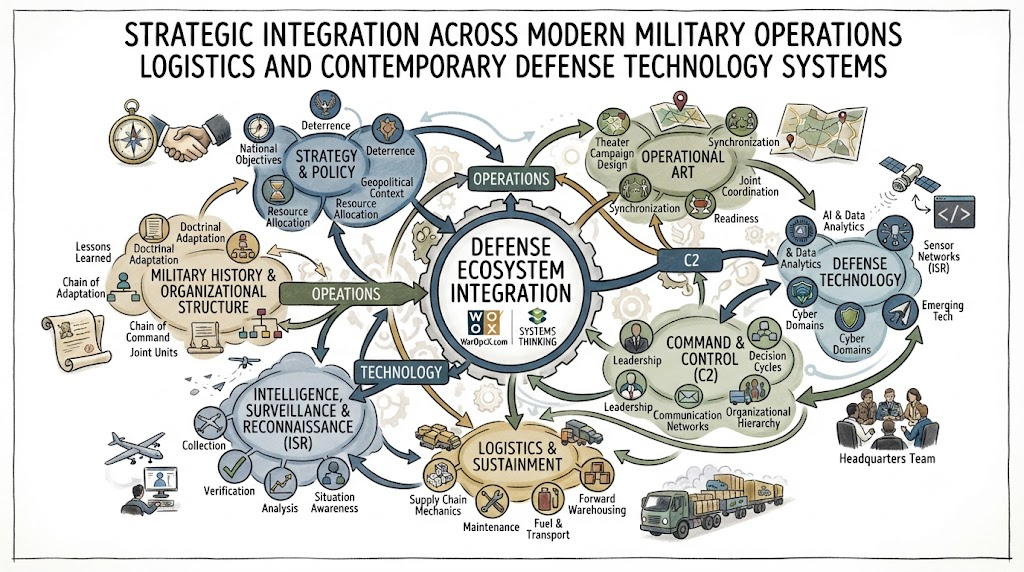
Modern defense study relies entirely on systems-thinking, where individual elements cannot be evaluated in isolation. A functional defense apparatus operates along an unbroken continuum: high-level strategy establishes primary objectives; operational plans coordinate joint assets; organizational structures establish authority; logistics sustains the deployment; technology empowers capabilities; and verified intelligence guides executive decisions. When these core elements become desynchronized, the entire enterprise experiences systemic degradation. Strategy without logistical sustainment quickly produces operational paralysis, just as cutting-edge technology without clear organizational chains of command creates operational confusion. The following comparative overview illustrates how these central pillars integrate to form a cohesive defense ecosystem.
| Area | What It Covers | Why It Matters |
| Military Strategy | National objectives, deterrence, and long-term planning | Aligns institutional capabilities with long-term national policy goals |
| Defense Studies | Multidisciplinary policy, economics, history, and security | Delivers broad geopolitical context beyond simple hardware inventories |
| Military Operations | Operational campaign planning and theater synchronization | Connects high-level strategy with real-world execution |
| Military Logistics | Supply chain management, distribution, and equipment maintenance | Ensures institutional readiness, force projection, and sustained deployments |
| Command and Control | Communications architecture, authority, and information flow | Preserves decision-making integrity and organizational command |
| Defense Technology | AI, uncrewed systems, cyber frameworks, and sensor suites | Expands organizational capabilities, responsiveness, and operational velocity |
| Military History | Historical campaigns, doctrine evolution, and systemic adaptations | Provides analytical precedent for evaluating contemporary defense dilemmas |
| Organizational Structure | Institutional hierarchy, joint commands, and accountability lines | Eliminates operational friction and establishes clear command lines |
| Multidomain Operations | Combined operations across land, sea, air, space, and cyber | Prevents single-domain isolation and leverages cross-domain capabilities |
| ISR | Systematic information collection, processing, and distribution | Mitigates uncertainty and provides actionable situational awareness |
Real-Life Scenarios / Experiences
- Logistical Bottlenecks in Rapid Deployments: An armored formation is deployed forward to reinforce a regional boundary, but the rail network lacks specialized railcars for heavy equipment, and forward fuel supplies run short. The entire force halts along transit corridors, proving that equipment numbers mean nothing without matched transport and fuel throughput.
- Command Severance Under Electronic Warfare: During a joint defense exercise, intense electronic interference disrupts satellite links between central headquarters and dispersed naval units. Formations with rigid, top-down command structures suffer operational paralysis, whereas units trained in distributed mission command use established commander’s intent to sustain coordinated defensive positioning.
- Sensor Saturation in Operational Centers: A maritime operations center receives simultaneous data streams from space-based radar, uncrewed aircraft, and regional sonar networks, overwhelming operational staff with uncurated alerts. Without automated data-triage pipelines and experienced intelligence analysts, decision velocity plummets despite superior technological surveillance assets.
- Cross-Domain Vulnerabilities in Fixed Infrastructure: A critical military logistics airfield depends entirely on a regional civilian power grid and local water pumping facilities. A sophisticated digital attack disrupts regional utility servers, paralyzing maintenance equipment and fueling systems, showing how non-military cyber vulnerabilities degrade physical operational readiness.
How to Use WarOpsX.Com for Structured Learning
- Step 1: Establish fundamental conceptual literacy by reviewing high-level introductory overviews of military strategy, institutional hierarchies, and foundational defense terminology.
- Step 2: Deepen your contextual understanding by exploring historical campaign case studies to see how strategic theories performed under practical resource and terrain constraints.
- Step 3: Examine military organizational architecture to understand how commands, branch relationships, administrative structures, and joint force integrations are organized.
- Step 4: Analyze operational planning modules to grasp theater-level geometry, coordination principles, phase-based planning, and strategic force posture.
- Step 5: Study logistical systems, supply chains, maintenance networks, and sustainment cycles to recognize the physical boundaries of operational deployments.
- Step 6: Review modern technological capabilities, including autonomous platforms, cyber architectures, sensor networks, and space-based communication links.
- Step 7: Synthesize your knowledge across multidomain integration and ISR operational frameworks, evaluating how information superiority and cross-domain maneuvers function together.
Who Can Benefit From WarOpsX.Com?
WarOpsX.com provides dedicated research resources for defense studies students, academic researchers, international relations scholars, public policy learners, military history enthusiasts, security analysts, and emerging technology professionals. Academic students leverage the platform to master foundational terminology, operational concepts, and historical contexts required for strategic coursework. Policy researchers and civil analysts utilize the clear structural breakdowns to examine defense acquisition timelines, inter-agency structures, and defense budget constraints without having to parse obscure tactical jargon. Meanwhile, technology engineers and strategic learners gain clear visibility into how automated platforms, cyber tools, and sensor suites integrate into wider organizational networks, fostering a practical, multidimensional understanding of defense ecosystems.
Why Understanding Defense as a System Matters
Analyzing defense capabilities through a systems-thinking lens prevents the common trap of reducing national security to isolated weapon comparisons, platform counts, or technological hype. Institutional readiness relies on the continuous, balanced interaction of personnel, command clarity, strategic vision, reliable logistics, resilient infrastructure, actionable intelligence, and adaptable doctrines. If any single structural node fails—whether through neglected supply networks, rigid hierarchies, or unverified intelligence—the entire operational apparatus experiences systemic collapse. Comprehensive defense platforms allow learners to perceive these critical dependencies, providing the analytical tools needed to understand how defense organizations maintain stability, deploy resources, and navigate an increasingly complex global environment.
Common Mistakes to Avoid
- Confusing Strategy with Field Tactics: Equating broad national defense goals with localized physical actions prevents learners from understanding high-level policy, regional deterrence, and long-term force posturing.
- Overemphasizing Hardware Over Logistics: Obsessing over the theoretical capabilities of advanced combat platforms while ignoring maintenance pipelines, spare parts inventories, and fuel distribution networks yields flawed capability assessments.
- Viewing Operational Domains in Isolation: Analyzing land, maritime, or air forces independently without considering space-based communications, cyber vulnerabilities, and electronic warfare environments produces incomplete operational perspectives.
- Treating Technology as an Automatic Solution: Assuming advanced digital software or artificial intelligence will immediately overcome defective organizational design, poor communications, or ambiguous command authority leads to unrealistic conclusions.
- Ignoring Interdisciplinary Geopolitical Realities: Evaluating defense maneuvers without studying geography, local economic constraints, industrial capacity, and diplomatic relationships leads to unrealistic assessments of military capability.
- Memorizing Historical Dates Instead of Mechanics: Learning historical battle timelines without examining the underlying logistics, intelligence failures, command structures, and environmental factors wastes the analytical value of military history.
- Overlooking the Operational Tier of Action: Jumping directly from abstract geopolitical objectives to small-unit tactical activities completely misses the vital operational planning, staging, and theater synchronization that make campaigns possible.
- Equating Raw Data Collection with Actionable Intelligence: Assuming that gathering massive quantities of radar or video surveillance equates to operational clarity ignores the essential processing, analysis, and validation phases of the ISR cycle.
Frequently Asked Questions
1. What is the core educational focus of WarOpsX.com?
The platform focuses on high-level educational analysis across military strategy, defense studies, operational planning, logistics, command systems, military history, and emerging technology. It strictly avoids tactical combat training and actionable weapons instruction, serving purely as an intellectual framework for understanding defense institutions, operational dependencies, and modern security environments.
2. How does military strategy differ from military operations?
Strategy establishes broad political and national security objectives, allocating institutional resources, assessing long-term risks, and creating deterrence models across years. Operations serve as the vital bridge beneath strategy, translating those policy goals into coordinated theater campaigns, resource distributions, and phased organizational maneuvers across assigned operational areas.
3. Why is military logistics considered a strategic priority?
Logistics determines the real-world limits of an organization’s mobility, deployability, and operational endurance over time. Without resilient supply chains, fuel transport, vehicle maintenance, munitions storage, and medical infrastructure, advanced combat platforms cannot operate effectively, resulting in rapid mission failure regardless of strategic intent.
4. What does the term Multidomain Operations mean in practice?
Multidomain operations describe the synchronized employment of joint capabilities across land, maritime, air, space, and cyberspace domains, along with the information environment. Rather than conducting separate, isolated domain campaigns, forces orchestrate cross-domain capabilities to generate compound advantages and protect vulnerable operational links.
5. What role does Command and Control play in defense systems?
Command and Control systems provide the administrative authority, communications architecture, and procedural frameworks required to coordinate dispersed forces. It ensures situational awareness, routes strategic directives, enables timely decision-making, and facilitates ongoing operational assessments across diverse organizational units during peace, crisis, or operational disruption.
6. How does defense technology interact with organizational design?
Advanced hardware and software platforms rely on sound organizational design, disciplined training, skilled personnel, robust maintenance, and resilient communications to function effectively. Technology is an institutional amplifier, not an independent solution; without clear organizational workflows, unvetted technological tools can complicate operations rather than streamline them.
7. What are the core stages of the intelligence cycle?
The operational intelligence cycle follows a disciplined sequence: collection of raw data, processing into structured formats, analytical evaluation, assessment of context and accuracy, and final dissemination to decision-makers. This structured process mitigates bias, filters out deceptive noise, and provides situational clarity for strategic planning.
8. Why should civilian researchers study defense organizational structures?
Studying institutional hierarchies, command chains, joint headquarters, and branch distributions reveals how defense organizations govern resources, establish accountability, and communicate internally. This structural understanding helps researchers assess defense budget requests, analyze inter-agency cooperation, and evaluate civil-military administration with academic rigor.
9. Can beginners without a military background use WarOpsX.com?
The educational materials are specifically structured to be accessible to curious beginners while maintaining the analytical depth required by researchers. Foundational concepts, institutional frameworks, and defense terminology are clearly explained before introducing complex organizational models, operational campaign interactions, and emerging multi-theater technological dilemmas.
10. How does studying military history improve modern defense analysis?
Military history provides real-world case studies demonstrating how doctrine, technology, geographic friction, and logistical constraints function under real-world conditions. Analyzing historical campaigns helps modern learners identify recurring organizational failures, technological transitions, and strategic mistakes, preventing modern analysts from repeating proven institutional missteps.
11. What is the difference between surveillance and reconnaissance?
Reconnaissance is a focused, task-oriented mission conducted to gather specific information about targeted areas, terrain, or forces. Surveillance is the persistent, systematic observation of an aerospace, surface, subsurface, or cyber zone over an extended duration to track operational patterns and maintain baseline situational awareness.
12. Why is systems thinking critical for defense studies students?
Defense organizations operate as integrated systems where changes to one element—such as procurement, logistics, communications, or strategy—directly reshape all other functional areas. Systems thinking prevents narrow analyses, ensuring students evaluate national security challenges through the realistic, interconnected relationships that dictate true institutional readiness.
Conclusion
The diversity of Kolkata’s event ecosystem showcases a bustling cultural and commercial environment filled with stage performances, corporate expos, literary gatherings, and neighborhood workshops. Navigating this dense urban calendar requires much more than simply finding an event; attendees must carefully verify venue locations, gate timings, parking access, transit connections, and ticketing policies to avoid disruptions. Utilizing dedicated digital event discovery platforms simplifies this complex coordination, consolidating scattered event details, schedule changes, and direct booking options into one accessible space. By providing structured event listings, venue directories, and localized updates, KolkataOrbit helps urban explorers discover relevant community events while ensuring their social outings remain smooth, well-planned, and hassle-free.
Leave a Reply