Analyzing DevSecOps Certified Professional (DSOCP) Skill Sets For Enterprise Scale Platform Reliability

September 16, 2026 · 6 reads
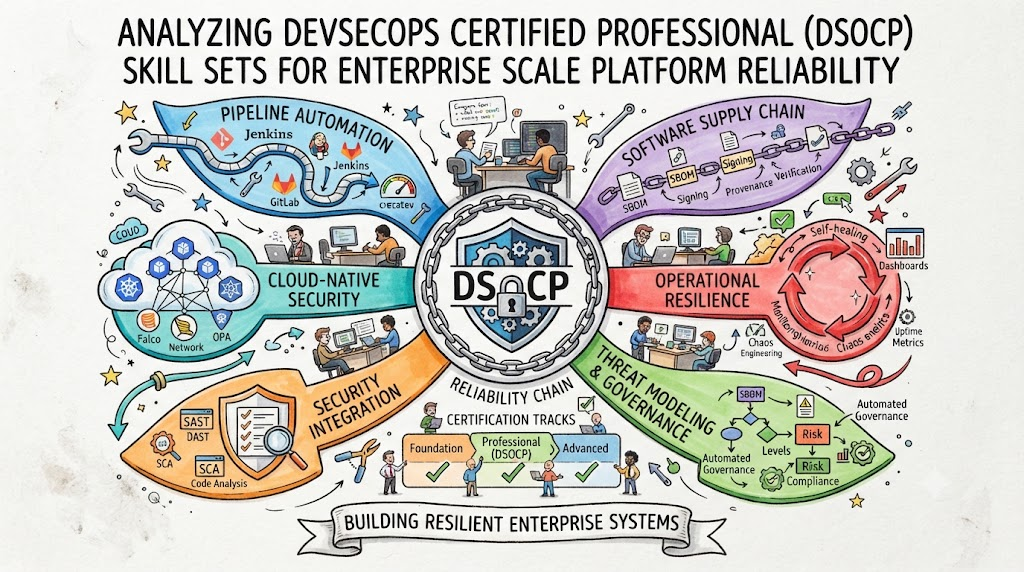
Introduction
Securing software delivery pipelines has shifted from an afterthought to a core engineering requirement across modern enterprises. The DevSecOps Certified Professional (DSOCP) is a credential designed to validate an engineer’s ability to embed automated security controls directly into continuous integration and continuous deployment workflows. This guide is written for software engineers, systems administrators, cloud architects, and security practitioners who need a clear roadmap for modern platform security.
As organizations scale their cloud-native infrastructure, the friction between fast feature releases and stringent compliance mandates becomes unsustainable. Traditional security audits conducted right before production deployments create bottlenecks, generate costly rework, and expose production environments to critical vulnerabilities. DevSecOps addresses this operational breakdown by shifting security practices left, making quality and compliance a shared responsibility across development, operations, and security teams.
Navigating the landscape of modern security certifications can be challenging given the abundance of vendor-specific tools and theoretical credentials. This comprehensive guide helps technology professionals evaluate whether the DevSecOps Certified Professional (DSOCP) aligns with their career trajectory, technical background, and long-term professional aspirations. Whether you are transitioning from standard infrastructure automation or looking to formalize your application security skills, the following sections provide practical clarity on curriculum depth, project requirements, and industry application.
What is the DevSecOps Certified Professional (DSOCP)?
The DevSecOps Certified Professional (DSOCP) represents a rigorous technical benchmark that confirms an engineer can design, implement, and maintain secure delivery pipelines. Unlike purely academic security credentials that emphasize policy governance and regulatory frameworks, this program focuses directly on engineering realities and implementation details. It exists to bridge the persistent operational divide between software engineering velocity and enterprise risk management.
Modern production systems run across distributed multi-cloud architectures, serverless runtimes, and complex container orchestration platforms. In these fast-moving environments, security policies written on static documents fail to prevent misconfigurations or zero-day exploits. The certification curriculum emphasizes hands-on infrastructure as code testing, continuous automated security scans, secret management orchestration, and runtime defense mechanisms.
By focusing on production-grade toolchains rather than isolated security theory, the program ensures candidates understand how to eliminate deployment blockers. Engineers learn how to establish automated guardrails that empower developers to push code rapidly without bypassing essential safety checks. It aligns directly with the architectural patterns established by leading enterprise engineering organizations worldwide.
Who Should Pursue DevSecOps Certified Professional (DSOCP)?
This credential is engineered for professionals across the technical spectrum who interact with modern delivery pipelines. Software developers seeking to write defensive code and understand how their dependencies impact system integrity will find immediate value in the curriculum. Infrastructure engineers, site reliability engineers, and platform professionals who manage infrastructure as code configurations benefit by learning how to enforce compliance policies programmatically before resources are provisioned.
Security analysts and traditional penetration testers aiming to transition into automated cloud environments will find the program essential for operational survival. The shift from manual audits to automated pipeline policy enforcement requires deep operational fluency with modern deployment systems. Furthermore, engineering managers, systems architects, and technical team leads who oversee digital modernization initiatives require this knowledge to set realistic governance standards without slowing team velocity.
The relevance of this certification spans both established enterprise hubs across North America and Europe, as well as rapid-growth technology ecosystems in India and Southeast Asia. Organizations across banking, financial services, healthcare, and software-as-a-service verticals actively seek engineers who can demonstrably safeguard intellectual property and customer data within distributed cloud footprints.
Why DevSecOps Certified Professional (DSOCP) is Valuable
The demand for cross-functional engineers who combine deep automation expertise with security vigilance continues to outstrip market supply. Automated pipelines accelerate code delivery, but unmonitored automation simply deploys vulnerabilities faster and at greater scale. Organizations recognize that relying solely on dedicated, siloed security operations teams results in critical blind spots and high remediation expenses after incidents occur.
Tool ecosystems change rapidly, with new scanners, container runtimes, and orchestration frameworks emerging constantly. The DevSecOps Certified Professional (DSOCP) emphasizes fundamental engineering patterns, defensive architectural design, and programmatic validation principles that outlast short-lived tool trends. Candidates learn how to evaluate security trade-offs, construct automated feedback loops, and design resilient delivery mechanisms that adapt as frameworks evolve.
Investing professional time into this specialization yields substantial career resilience and operational credibility. As businesses face stricter data sovereignty mandates, software supply chain security standards, and frequent infrastructure attacks, teams require engineers who can actively safeguard production environments. Holding an industry-aligned credential signals to employers that an engineer possesses the pragmatic skills needed to secure mission-critical platforms without compromising development throughput.
DevSecOps Certified Professional (DSOCP) Certification Overview
The DevSecOps Certified Professional (DSOCP) program is delivered via official training pathways and structured validation modules hosted on DevOpsSchool. The curriculum is constructed around an engineering-first pedagogy that tests practical problem-solving over passive conceptual memorization. Candidates are guided through architectural design exercises, hands-on lab environments, and realistic failure injection scenarios.
Assessment throughout the program prioritizes real-world application, requiring learners to configure complete delivery pipelines, integrate automated scanning utilities, and resolve complex pipeline failures under realistic operational constraints. Ownership of the credential resides with seasoned industry practitioners who continuously update course content to reflect active threats, industry security benchmarks, and emerging delivery paradigms.
The structure balances core pipeline hardening concepts with granular security domains, including static source code analysis, dynamic application testing, software composition analysis, and cloud configuration monitoring. By setting distinct milestones across each operational phase, the program provides clear evidence of an engineer’s technical capability to design production-grade security architectures.
DevSecOps Certified Professional (DSOCP) Certification Tracks & Levels
The certification framework is organized into progressive competency levels that mirror an engineer’s career maturation. The foundational track introduces core terminology, security mindset cultivation, and basic integration mechanics for continuous integration systems. It establishes the baseline knowledge required to navigate modern enterprise software development lifecycles.
The professional tier dives deeply into production tooling, pipeline orchestration, compliance automation, and container security. At this level, engineers master the balance between gate enforcement and developer experience, ensuring automated security checks do not become deployment bottlenecks. Candidates work directly with infrastructure as code scanners, secret management vaults, and software bill of materials generators.
The advanced track is tailored for senior architects, principal engineers, and security leads responsible for organizational governance, threat modeling, and distributed security telemetry. This tier covers advanced runtime protection, zero-trust network policy design, and automated incident triage systems. Together, these tracks establish a transparent roadmap that connects hands-on technical skills with broad enterprise platform leadership.
Complete DevSecOps Certified Professional (DSOCP) Certification Table
| Track | Level | Who it’s for | Prerequisites | Skills Covered | Recommended Order |
| Foundation Security | Entry to Intermediate | Junior Developers, QA Engineers, Junior SysAdmins | Basic Linux, Git workflows, Basic CI/CD concepts | Static analysis basics, secret scanning, pipeline hygiene | 1 |
| DevSecOps Professional | Intermediate to Advanced | DevOps Engineers, Cloud Engineers, Security Analysts | 2+ years DevOps or Cloud experience, Scripting | SAST, DAST, SCA, Container Hardening, Policy as Code | 2 |
| Cloud Security Platform | Intermediate to Advanced | Platform Engineers, Cloud Architects, Systems Engineers | Cloud fundamentals, Infrastructure as Code skills | Cloud security posture, IAM governance, IaC scanning | 3 |
| Runtime & Container Defense | Advanced | SREs, Kubernetes Operators, Security Engineers | Docker, Kubernetes administration, Linux internals | Admission controllers, runtime auditing, service mesh | 4 |
| Security Governance & Architecture | Expert / Leadership | Principal Engineers, Security Architects, Tech Leads | Broad infrastructure and security architecture background | Threat modeling, compliance automation, SBOM management | 5 |
Detailed Guide for Each DevSecOps Certified Professional (DSOCP) Certification
DevSecOps Certified Professional (DSOCP) – Foundation Security
What it is
This certification validates core competency in identifying baseline security vulnerabilities within source code and continuous integration setups. It ensures that an engineer understands how automated checks function within daily development workflows.
Who should take it
Junior software developers, quality assurance engineers, and operations technicians looking to build practical application security fundamentals. It is ideal for individuals with zero to two years of technical experience seeking a structured entry point into automated security.
Skills you’ll gain
- Identification of common code vulnerabilities matching industry top-ten risk lists
- Integration of secret scanning tools into local and remote Git repositories
- Execution of basic static application security testing within build pipelines
- Configuration of pre-commit hooks to prevent credential leakage
- Understanding the role of package managers in software dependency risk
Real-world projects you should be able to do
- Configure automated Git pre-commit hooks that detect and block hardcoded API tokens and private keys
- Implement an automated static code scanner inside a GitHub Actions or GitLab CI pipeline
- Build an automated notification pipeline that flags vulnerable open-source dependencies on pull requests
Preparation plan
- 7–14 days plan: Focus exclusively on Git security fundamentals, repository scanning utilities, and common web application security risks.
- 30 days plan: Set up local build systems, configure static scanning tools on open-source repositories, and complete foundational lab exercises.
- 60 days plan: Deep dive into software dependency mechanics, build automated pipeline integrations from scratch, and practice interpreting security scan logs.
Common mistakes
- Relying exclusively on manual code reviews instead of understanding automated scanner configuration
- Ignoring tool output warnings and failing to differentiate between true alerts and noisy false positives
- Treating security as an isolated step rather than embedding it into developer Git workflows
Best next certification after this
- Same-track option: DevSecOps Certified Professional (DSOCP) – Core Professional Level
- Cross-track option: Certified Kubernetes Administrator (CKA)
- Leadership option: Certified Agile Technical Team Lead
DevSecOps Certified Professional (DSOCP) – Core Professional Level
What it is
This credential validates an engineer’s ability to implement end-to-end automated security pipelines across containerized applications and cloud environments. It serves as the benchmark for hands-on, production-grade DevSecOps engineering capability.
Who should take it
DevOps engineers, cloud practitioners, and systems engineers with two to five years of industry experience. It is designed for engineers actively responsible for managing deployment workflows and continuous integration environments.
Skills you’ll gain
- End-to-end integration of SAST, DAST, and SCA tooling into enterprise pipelines
- Container image vulnerability scanning, minimization, and base image hardening
- Automated infrastructure as code scanning for configuration drift and security regressions
- Implementation of centralized secret management solutions within automated jobs
- Definition of pipeline security gates based on vulnerability severity thresholds
Real-world projects you should be able to do
- Design a multi-stage deployment pipeline that runs SAST, SCA, and container scans with defined failure gates
- Implement HashiCorp Vault to dynamically inject short-lived credentials into build runners
- Build an automated Dockerfile hardening pipeline that outputs minimal, rootless production container images
Preparation plan
- 7–14 days plan: Review pipeline syntax, container inspection tools, and policy-as-code syntax through intensive lab sessions.
- 30 days plan: Construct complete sample delivery pipelines integrating at least three distinct automated security scanning engines.
- 60 days plan: Implement complete multi-tier deployment workflows, conduct false-positive triage drills, and build automated gate enforcement policies.
Common mistakes
- Configuring security scans to run without establishing clear policy thresholds or build-breaking criteria
- Storing static secrets within pipeline variables rather than using dynamic secret engines
- Overwhelming development teams by dumping raw scanner outputs without automated filtering
Best next certification after this
- Same-track option: DevSecOps Certified Professional (DSOCP) – Runtime & Container Defense
- Cross-track option: Certified Site Reliability Engineer (CSRE)
- Leadership option: DevSecOps Engineering Manager Certification
DevSecOps Certified Professional (DSOCP) – Cloud Security Platform
What it is
This track validates proficiency in enforcing security standards across public cloud services and infrastructure as code templates. It demonstrates an engineer’s capability to govern cloud infrastructure programmatically before and after provisioning.
Who should take it
Cloud engineers, infrastructure architects, and platform team members who manage scalable environments on AWS, Azure, or Google Cloud. Candidates should possess solid familiarity with infrastructure provisioning tools like Terraform or CloudFormation.
Skills you’ll gain
- Automated validation of Terraform and CloudFormation configurations against security baselines
- Implementation of policy-as-code engines to prevent non-compliant cloud resource creation
- Configuration of cloud identity and access management policies following least-privilege principles
- Auditing cloud security posture management tools and interpreting compliance reports
- Automation of cloud security logging, auditing, and anomaly detection workflows
Real-world projects you should be able to do
- Develop a suite of Open Policy Agent rules that prevent provisioning unencrypted storage volumes or public load balancers
- Build a continuous cloud compliance pipeline that scans Terraform plans before execution
- Automate the deployment of centralized audit logging across multi-account cloud topologies
Preparation plan
- 7–14 days plan: Focus on infrastructure as code scanning utilities, cloud IAM evaluation, and policy syntax mechanics.
- 30 days plan: Build policy-as-code checks for popular cloud architectures and integrate them into automated pull request workflows.
- 60 days plan: Create comprehensive cloud compliance systems covering multi-account identity, network segmentation, and automated remediation.
Common mistakes
- Relying solely on cloud provider console alerts rather than automating pre-deployment checks
- Creating overly permissive IAM roles and wildcards to bypass pipeline permission issues
- Failing to test policy rules against edge-case infrastructure deployment scenarios
Best next certification after this
- Same-track option: DevSecOps Certified Professional (DSOCP) – Security Governance & Architecture
- Cross-track option: Cloud FinOps Certified Practitioner
- Leadership option: Cloud Platform Director Certification
DevSecOps Certified Professional (DSOCP) – Runtime & Container Defense
What it is
This credential validates operational mastery over container runtime environments, service mesh topologies, and Kubernetes cluster security. It confirms an engineer can safeguard workloads actively running in dynamic production clusters.
Who should take it
Site reliability engineers, Kubernetes administrators, and security operations personnel tasked with protecting production microservice architectures. Candidates must possess practical experience managing containerized workloads.
Skills you’ll gain
- Hardening Kubernetes cluster configurations according to industry benchmark standards
- Implementation of dynamic admission controllers to block non-compliant deployments
- Configuration of runtime threat detection engines to monitor anomalous system calls
- Enforcement of container network policies and zero-trust service communication rules
- Management of cryptographically signed container images and provenance verification
Real-world projects you should be able to do
- Deploy and configure Falco to alert on anomalous shell executions inside production pods
- Implement Kyverno or Gatekeeper admission policies that enforce read-only root filesystems
- Set up mutual TLS and granular communication rules between microservices using a service mesh
Preparation plan
- 7–14 days plan: Study Kubernetes security contexts, admission webhooks, and Linux kernel monitoring primitives.
- 30 days plan: Deploy runtime monitoring tools into test clusters, simulate privilege escalation exploits, and tune detection alerts.
- 60 days plan: Architect a zero-trust Kubernetes environment with admission validation, signed image enforcement, and micro-segmentation.
Common mistakes
- Assuming container vulnerability scanning at build time eliminates the need for runtime monitoring
- Neglecting Linux capabilities and running application containers with root privileges
- Writing overly complex network policies that disrupt microservice communication and create production outages
Best next certification after this
- Same-track option: DevSecOps Certified Professional (DSOCP) – Security Governance & Architecture
- Cross-track option: Certified Reliability Engineer / Advanced SRE
- Leadership option: Enterprise Infrastructure Security Officer
DevSecOps Certified Professional (DSOCP) – Security Governance & Architecture
What it is
This advanced credential validates high-level competency in designing holistic enterprise security architectures, managing software supply chain risks, and establishing compliance automation. It certifies the strategic and architectural capability of senior engineering leaders.
Who should take it
Principal engineers, security architects, technical directors, and enterprise platform leads responsible for establishing organizational security roadmaps. Candidates should bring over seven years of cumulative engineering and systems design experience.
Skills you’ll gain
- Threat modeling for complex cloud-native architectures and distributed systems
- Automated generation, signing, and verification of Software Bills of Materials (SBOM)
- Establishing organizational vulnerability management workflows and remediation service level agreements
- Translating regulatory compliance standards into continuous automated technical controls
- Designing resilient enterprise secret orchestration and key rotation architectures
Real-world projects you should be able to do
- Design a comprehensive software supply chain security framework verifying artifact signatures across all stages
- Conduct enterprise threat modeling on a distributed financial transaction platform and produce architectural mitigations
- Build an automated compliance reporting engine that gathers evidence directly from infrastructure state files
Preparation plan
- 7–14 days plan: Review modern enterprise threat modeling frameworks, supply chain attack vectors, and compliance standards.
- 30 days plan: Develop complete software bill of materials ingestion and verification architectures for multi-tier applications.
- 60 days plan: Create end-to-end governance blueprints that unify policy enforcement, supply chain validation, and automated executive reporting.
Common mistakes
- Focusing exclusively on high-level documentation without understanding underlying technical execution
- Mandating strict security gates without establishing clear self-service tooling for developers
- Failing to design resilient fallback mechanisms when security scanning platforms experience outages
Best next certification after this
- Same-track option: Specialized Enterprise Threat Hunter
- Cross-track option: Executive Enterprise Architect Certification
- Leadership option: Chief Information Security Officer (CISO) Executive Program
Choose Your Learning Path
DevOps Path
The DevOps path focuses on integrating security mechanisms seamlessly into high-velocity continuous integration and continuous deployment environments. Engineers following this route master the art of embedding static analyzers, container linters, and secret scanners into automated workflows without inflating pipeline runtimes. The goal is to provide developers with fast, actionable feedback at the pull request stage, making security an automated quality gate rather than a manual roadblock.
DevSecOps Path
The dedicated DevSecOps path delivers a comprehensive, deep-dive exploration of modern offensive and defensive application security. Practitioners on this track specialize in configuring and optimizing complex application scanners, establishing dynamic runtime analysis environments, and managing policy-as-code frameworks. This path produces domain specialists capable of designing robust automated guardrails, remediating zero-day pipeline disruptions, and leading technical security transformations across enterprise delivery teams.
SRE Path
The Site Reliability Engineering path focuses on runtime operational resilience, system observability, and workload isolation under failure or attack conditions. Engineers pursuing this track learn how to connect security telemetry with system health metrics, monitor anomalous kernel events, and configure dynamic admission controls on container clusters. The core objective is maintaining system availability, reliability, and data confidentiality simultaneously, even when underlying infrastructure components face active exploitation.
AIOps Path
The AIOps path centers on leveraging machine learning models and automated anomaly detection algorithms to analyze massive streams of system telemetry and security audit logs. Practitioners following this route learn how to configure intelligent alert correlation engines that filter out operational noise and highlight genuine security incidents. This specialization prepares professionals to build self-healing infrastructure systems capable of identifying and mitigating unauthorized access patterns before human operators can intervene.
MLOps Path
The MLOps path addresses the distinct security challenges inherent in machine learning model development, data ingestion pipelines, and inference deployments. Engineers on this track specialize in securing training data pipelines, preventing adversarial data poisoning, managing model artifact lineage, and protecting proprietary model weights from exfiltration. This pathway is critical for organizations operationalizing artificial intelligence systems that must comply with strict data privacy mandates and model governance frameworks.
DataOps Path
The DataOps path applies continuous security and automated governance principles directly to large-scale data engineering workflows and analytical platforms. Professionals on this track learn how to implement automated data masking, enforce role-based access control across distributed storage lakes, and validate data schema integrity in transit. This route ensures that modern data pipelines deliver timely business intelligence while maintaining stringent compliance with enterprise security baselines and international data protection laws.
FinOps Path
The FinOps path combines financial accountability with platform security governance, recognizing that infrastructure misconfigurations often lead directly to catastrophic cloud cost overruns. Engineers pursuing this path learn how security controls, such as enforcing resource termination policies and eliminating orphaned assets, prevent unauthorized resource hijacking and cryptojacking attacks. This specialization equips professionals to optimize enterprise cloud budgets while simultaneously strengthening infrastructure attack surfaces against financial exploitation.
Role to Recommended DevSecOps Certified Professional (DSOCP) Certifications
| Role | Primary Recommended Certification | Secondary Focus Track | Strategic Value |
| DevOps Engineer | DevSecOps Certified Professional (DSOCP) – Core Professional Level | Foundation Security | Enables frictionless pipeline automation with built-in security checks |
| SRE | DevSecOps Certified Professional (DSOCP) – Runtime & Container Defense | Cloud Security Platform | Hardens production runtime environments against active threats and outages |
| Platform Engineer | DevSecOps Certified Professional (DSOCP) – Cloud Security Platform | Core Professional Level | Provides secure, compliant self-service platform infrastructure to developers |
| Cloud Engineer | DevSecOps Certified Professional (DSOCP) – Cloud Security Platform | Runtime & Container Defense | Ensures public cloud environments adhere strictly to security baselines |
| Security Engineer | DevSecOps Certified Professional (DSOCP) – Core Professional Level | Security Governance & Architecture | Transforms manual security audits into automated pipeline guardrails |
| Data Engineer | DevSecOps Certified Professional (DSOCP) – Foundation Security | Cloud Security Platform | Protects distributed data pipelines, ETL workflows, and storage systems |
| FinOps Practitioner | DevSecOps Certified Professional (DSOCP) – Foundation Security | Cloud Security Platform | Identifies unauthorized resource sprawl and mitigates security cost risks |
| Engineering Manager | DevSecOps Certified Professional (DSOCP) – Security Governance & Architecture | Core Professional Level | Establishes strategic security governance without degrading release velocity |
Next Certifications to Take After DevSecOps Certified Professional (DSOCP)
Same Track Progression
After securing foundational and professional DevSecOps credentials, continuing along the primary technical track demands deep architectural specialization. Professionals should target elite credentials focusing on advanced container runtime analysis, automated kernel-level auditing, and sophisticated software supply chain defense frameworks. Mastery of dynamic policy engines, cryptographic artifact signing, and zero-trust mesh networking solidifies an engineer’s position as a top-tier security engineering authority.
Advancing within the same track also involves gaining expertise in automated vulnerability triage, complex compliance mapping, and custom security plugin development. High-level specialization ensures you can step into critical enterprise scenarios where out-of-the-box security utilities fall short, allowing you to engineer proprietary security automation tailored to complex regulatory demands and bespoke distributed systems.
Cross-Track Expansion
Modern technology leadership requires breadth across adjacent operational disciplines to avoid single-domain myopia. Engineers holding the DevSecOps Certified Professional (DSOCP) benefit immensely by pursuing advanced Site Reliability Engineering certifications to master reliability metrics, error budgets, and chaos engineering. Understanding how security measures influence system latency, operational headroom, and platform availability makes an engineer exceptionally valuable to enterprise organizations.
Similarly, expanding into FinOps or Platform Engineering frameworks allows practitioners to view infrastructure through the lenses of economic efficiency and developer productivity. Learning to automate infrastructure provisioning while maintaining strict budgetary limits and security policies transforms an engineer into a versatile technical asset capable of operating across traditional organizational silos.
Leadership & Management Track
For senior engineers transitioning toward leadership roles, the natural progression moves beyond individual pipeline configuration toward organizational governance and engineering strategy. Professionals should pursue enterprise architecture credentials, technical leadership programs, and executive information security management tracks. These programs develop essential skills in cross-team negotiation, risk management frameworks, resource allocation, and technical hiring.
Leadership education ensures that senior professionals can effectively articulate technical security debt to C-suite executives and board members. It bridges the communication gap between hands-on engineering realities and broad corporate governance, empowering leaders to foster a culture of shared security accountability across hundreds of software developers, product owners, and platform engineers.
Training & Certification Support Providers for DevSecOps Certified Professional (DSOCP)
DevOpsSchool
DevOpsSchool is an established training organization focused on delivering deep technical instruction across modern delivery, cloud, and infrastructure automation domains. The platform provides instructor-led enterprise upskilling programs, practical hands-on laboratories, and comprehensive certification preparation courses tailored to working professionals. Their curriculum structures emphasize production-grade pipeline construction, modern deployment workflows, and practical security integration techniques designed to solve real operational bottlenecks. By focusing on real-world implementation projects rather than passive exam preparation, DevOpsSchool helps engineers build measurable competence that translates directly to enterprise environments, making it a reliable destination for professionals seeking career advancement in automated systems engineering.
Cotocus
Cotocus operates as an IT consulting and professional training firm that specializes in infrastructure modernization, enterprise automation, and organizational digital enablement. Their instructional model connects seasoned industry practitioners directly with corporate engineering teams and individual learners looking to master cloud-native toolchains. With coursework built around contemporary engineering standards, Cotocus emphasizes practical architectural design, continuous testing integration, and robust infrastructure management. Their programs assist organizations in modernizing legacy operational processes while empowering technical staff with the requisite skills to build, maintain, and secure complex deployment platforms across modern cloud-native infrastructures.
Scmgalaxy
Scmgalaxy is a widely recognized community knowledge base and technical training platform dedicated to source code management, configuration engineering, and modern DevOps methodologies. It provides an extensive repository of tutorials, instructional workshops, troubleshooting guides, and certification resources designed to support software engineers throughout their professional journeys. The platform’s educational offerings emphasize practical tooling fluency, operational automation, and efficient delivery practices. By serving as an active technical community hub, Scmgalaxy helps engineers troubleshoot complex deployment challenges, master version control orchestration, and implement dependable continuous integration workflows across diverse software application architectures.
BestDevOps
BestDevOps functions as a curated knowledge portal and professional learning directory focused on highlighting leading practices, emerging tools, and top training pathways across the DevOps ecosystem. The platform publishes objective comparisons of deployment frameworks, career roadmaps, and educational opportunities to help engineers make informed upskilling decisions. By analyzing industry trends and curriculum rigor, BestDevOps guides technology professionals toward credible programs that provide tangible return on learning investments. Its practical resources assist software practitioners in staying abreast of shifting platform standards, containerization technologies, and modern automation methodologies critical for ongoing professional relevance.
devsecopsschool.com
devsecopsschool.com is a focused educational platform dedicated exclusively to the disciplines of pipeline hardening, automated compliance, and cloud application security. Recognizing that traditional operations training often overlooks vital security engineering requirements, this specialized platform provides deep-dive courses on static analysis, container runtime protection, and policy-as-code automation. The instructional programs are constructed for developers, platform engineers, and security analysts who need to integrate defensive controls directly into rapid continuous integration pipelines. By maintaining an exclusive focus on defensive automation, the platform equips technical professionals with the necessary skills to eliminate vulnerabilities early in the software delivery process.
sreschool.com
sreschool.com specializes in curriculum and hands-on training centered around Site Reliability Engineering, distributed systems resilience, and enterprise platform observability. The institution educates infrastructure engineers on modern practices for maintaining high availability, establishing meaningful service level objectives, managing incident response, and executing chaos engineering drills. Through a blend of theoretical frameworks and realistic production simulation environments, learners gain the competence required to manage complex microservice platforms at scale. The platform serves as a targeted training resource for organizations and engineers determined to build dependable, self-healing systems that meet aggressive enterprise reliability requirements.
aiopsschool.com
aiopsschool.com delivers cutting-edge instruction focused on the intersection of artificial intelligence, machine learning operations, and enterprise IT infrastructure management. The school prepares platform engineers and systems administrators to deploy automated telemetry analysis, predictive incident detection, and algorithmic event correlation solutions across distributed cloud topologies. Its curriculum demystifies the process of integrating intelligent machine models into operational workflows, enabling technical teams to reduce alert fatigue and accelerate root-cause analysis. By emphasizing practical implementation strategies, aiopsschool.com helps organizations evolve from reactive troubleshooting practices toward proactive, autonomous infrastructure operations.
dataopsschool.com
dataopsschool.com provides specialized technical training designed to bring continuous delivery discipline, automated testing, and agile operational practices to big data engineering. The platform addresses the unique challenges of managing distributed data pipelines, complex analytical models, and large-scale storage environments. Through structured coursework, data engineers, architects, and analysts learn how to implement automated data validation, orchestrate ETL delivery workflows, and enforce security policies across complex information architectures. The platform’s mission is to help organizations eliminate data processing bottlenecks while improving data quality, system reliability, and overall engineering velocity.
finopsschool.com
finopsschool.com focuses on the financial governance, unit economics, and cost-optimization practices essential for running scalable cloud-native platforms efficiently. The educational platform bridges the communication and operational gap between engineering teams, finance departments, and business leadership. Students learn how to analyze complex cloud billing structures, enforce programmatic resource utilization policies, eliminate infrastructure waste, and establish transparent cost-allocation models. By teaching engineers to view architecture through the lens of business value and capital efficiency, finopsschool.com enables technology organizations to innovate rapidly in public clouds without experiencing unexpected budget overruns.
Frequently Asked Questions
1. What is the fundamental difference between standard DevOps and DevSecOps?
DevOps focuses primarily on accelerating software delivery velocity, automating infrastructure provisioning, and breaking down operational silos between software developers and IT systems teams.
DevSecOps fundamentally integrates security practices, automated risk scanning, and compliance policies directly into that continuous delivery pipeline, ensuring speed does not come at the expense of system integrity.
2. How difficult is it to earn the DevSecOps Certified Professional (DSOCP)?
The difficulty level is moderate to advanced, depending entirely upon your background in automation pipelines and security fundamentals.
Candidates who possess hands-on familiarity with Linux, continuous integration tools, and basic cloud networking generally navigate the technical coursework smoothly within two to three months of structured study.
3. Are there mandatory prerequisites before registering for this credential?
There are no formal administrative barriers or mandatory exam prerequisites required prior to beginning the certification track.
However, candidates should possess a functional understanding of Git version control, basic command-line Linux administration, and general software development lifecycle concepts to maximize the educational value.
4. What is the typical return on investment for an engineer earning this certification?
Professionals holding verified security automation credentials frequently command salary premiums of fifteen to twenty-five percent over generalist infrastructure peers.
Beyond compensation metrics, it dramatically increases employability across heavily regulated industries such as banking, digital payments, healthcare, and enterprise software platforms.
5. How much time should a working engineer dedicate to weekly preparation?
Most successful candidates allocate approximately six to eight hours per week across a standard ten-week preparation cycle.
Balancing theoretical reading with daily hands-on laboratory exercises ensures that pipeline configurations, tool integrations, and scanning scripts become natural operational habits.
6. Can a traditional software developer transition smoothly into DevSecOps?
Yes, software developers often make exceptional DevSecOps practitioners because they already understand software architecture, package dependencies, and build tools.
Learning how to incorporate security scanners, manage container configurations, and secure deployment infrastructure allows developers to transition naturally into specialized security engineering roles.
7. How does the curriculum address rapid shifts in vendor-specific security tools?
The certification structure focuses primarily on architectural patterns, defensive engineering methodologies, and standard data exchange formats rather than isolated tool syntaxes.
While students gain deep practical experience with popular utilities, the underlying concepts apply directly across competing commercial and open-source security toolchains.
8. Is this program suitable for systems administrators managing on-premises infrastructure?
Yes, traditional administrators looking to modernize their technical profile will find the curriculum highly valuable for learning cloud-native delivery concepts.
The skills gained in container isolation, automated configuration scanning, and credential governance apply directly to both modern hybrid data centers and public cloud footprints.
9. In what order should an engineer pursue multiple platform certifications?
It is generally recommended to start with foundational Linux and continuous integration proficiency before tackling core cloud platform credentials.
Once you understand basic automated infrastructure delivery, pursuing DevSecOps certification provides the specialized differentiation that sets you apart from typical operations engineers.
10. How are candidate technical skills assessed throughout the program?
Assessments are conducted through practical laboratory evaluations, scenario-based configuration challenges, and real-world pipeline implementation tasks.
Candidates must demonstrate their ability to resolve actual security failures, tune false-positive alerts, and secure realistic production architectures under guided evaluation criteria.
11. Does the certification cover compliance frameworks like SOC2, HIPAA, or ISO 27001?
The curriculum explains how automated technical controls map directly to high-level regulatory compliance mandates and enterprise security frameworks.
Engineers learn how to programmatically generate verifiable audit trails, enforce least-privilege configurations, and prove compliance status continuously without relying on manual paperwork.
12. Why is hands-on laboratory practice prioritized over multiple-choice exam models?
Enterprise engineering organizations require professionals who can actively diagnose, configure, and troubleshoot complex pipeline failures in live production systems.
Multiple-choice testing fails to evaluate an engineer’s true operational capability, whereas hands-on laboratory implementation proves practical problem-solving competency.
FAQs on DevSecOps Certified Professional (DSOCP)
1. What specific security domains are emphasized inside the DevSecOps Certified Professional (DSOCP) curriculum?
The program provides exhaustive coverage across four critical operational domains: static source code auditing (SAST), dynamic runtime testing (DAST), software composition analysis (SCA) for third-party dependencies, and container infrastructure hardening. Candidates learn to implement these utilities directly into automated delivery pipelines, set custom failure gates, and triage scanner findings efficiently.
Additionally, the curriculum covers secret management automation, cloud security posture baselines, and infrastructure as code validation. By addressing the entire lifecycle from source commit to production runtime, the program ensures engineers possess the operational depth needed to protect complex cloud-native architectures against common exploit vectors.
2. How does holding this credential impact job opportunities in India and the global market?
Enterprises across India, North America, Europe, and Southeast Asia are aggressively recruiting engineers who can bridge the traditional gap between rapid software delivery and defensive infrastructure security. Holding this credential validates to hiring managers that you possess practical engineering capability rather than merely theoretical policy knowledge.
Candidates frequently transition into high-demand roles such as DevSecOps Engineer, Cloud Security Architect, Platform Security Specialist, and Lead Automation Engineer. The measurable demand for cross-functional practitioners consistently results in faster career advancement and expanded options across enterprise tech hubs globally.
3. Does this certification require extensive background in offensive security or ethical hacking?
No extensive background in penetration testing, binary exploitation, or offensive security is required to successfully master the curriculum. The primary focus of the program is defensive engineering, automated pipeline architecture, continuous auditing, and the proactive elimination of structural misconfigurations.
While understanding basic vulnerability concepts like cross-site scripting or injection flaws is helpful, the coursework teaches you how to automate detection tools that identify these vulnerabilities programmatically. The objective is establishing sustainable security guardrails rather than conducting manual red-team intrusion assessments.
4. How does the DevSecOps Certified Professional (DSOCP) compare with general cloud security credentials?
General cloud security certifications usually focus broadly on vendor-specific console administration, broad identity policy management, and high-level architectural design across a single cloud ecosystem. They rarely explore the intricate mechanics of continuous integration pipelines, automated code testing, or developer workflows.
The DevSecOps Certified Professional (DSOCP) focuses specifically on the automated delivery engine itself, teaching engineers how to secure applications across multi-cloud and containerized environments. It provides deep, actionable skills in automating security checks within modern source control systems and delivery pipelines regardless of the underlying cloud hosting provider.
5. How are false-positive scan results handled within the course laboratory exercises?
One of the most valuable aspects of the practical curriculum involves learning how to tune scanning engines to avoid developer notification fatigue. In production environments, poorly configured scanners generate thousands of inconsequential warnings that tempt software engineering teams to bypass security gates entirely.
Students are taught how to establish sensible severity baselines, write custom exclusion rules, and configure intelligent filtering mechanisms. You will practice triaging automated scanner outputs, whitelisting validated exceptions, and designing pragmatic enforcement policies that maintain high security without halting active software deployment velocity.
6. What level of programming or scripting experience is necessary to complete the program?
Candidates should possess basic familiarity with at least one common scripting language, such as Bash or Python, along with an understanding of structured data formats like YAML and JSON. Most modern continuous integration workflows, infrastructure templates, and policy-as-code engines rely heavily on declarative YAML definitions.
The program does not require you to write complex application algorithms from scratch. Instead, you must be able to read application manifests, modify pipeline configuration files, write simple automation scripts, and interpret error output logs produced by automated security scanners during execution.
7. How does this certification address software supply chain risks and dependency management?
Software supply chain integrity is a core component of the program, reflecting the surging frequency of malicious package injections and upstream dependency vulnerabilities. The coursework guides candidates through automated software composition analysis (SCA) to identify outdated or compromised open-source libraries before application binaries are compiled.
Engineers also gain practical experience generating, verifying, and signing Software Bills of Materials (SBOM) using modern industry standards. You will learn how to enforce cryptographic verification policies that ensure only authenticated, untampered container images and deployment artifacts reach your live production clusters.
8. What kind of ongoing community or mentoring support is available to candidates?
Enrolled engineers gain access to dedicated community discussion forums, peer interaction channels, and direct mentorship from experienced platform security practitioners. This collaborative environment ensures that learners are never left stranded when confronting difficult pipeline configuration bugs or complex architectural design exercises.
Mentors provide targeted feedback on project implementations, offer guidance on resolving realistic lab scenarios, and share valuable insights on current enterprise engineering hiring practices. This active support structure ensures candidates successfully translate their educational milestones into measurable career advancement.
Final Thoughts: Is DevSecOps Certified Professional (DSOCP) Worth It?
Making a deliberate investment in your technical education requires balancing the dedication of personal time against the realistic likelihood of meaningful career progression. The technology industry routinely cycles through transient buzzwords, rebranded methodologies, and marketing-driven product categories that promise revolutionary transformations but deliver minimal operational change. Choosing which competencies to develop requires separating superficial trends from structural industry shifts.
The requirement to secure software delivery pipelines is not an optional operational phase that organizations will abandon in future budget cycles. As businesses deploy increasingly complex architectures across multi-cloud footprints, automated security integration becomes the only viable method for protecting critical data assets without grinding feature releases to a halt. The persistent shortage of engineers who combine continuous integration mechanics with proactive defensive security practices makes this one of the most stable, high-impact specializations in the technology sector.
If you are an engineer who enjoys bridging disparate disciplines, automating repetitive processes, and solving architectural challenges that span both software design and systems operations, the DevSecOps Certified Professional (DSOCP) provides exceptional educational and professional value. It provides a structured, production-tested framework that transitions your skill set from basic deployment administration to comprehensive platform defense, securing your relevance as an indispensable engineering asset for years to come.
Leave a Reply