Building Better Software Stability Using Modern Site Reliability Engineering Principles In Practice

September 22, 2026 · 13 reads
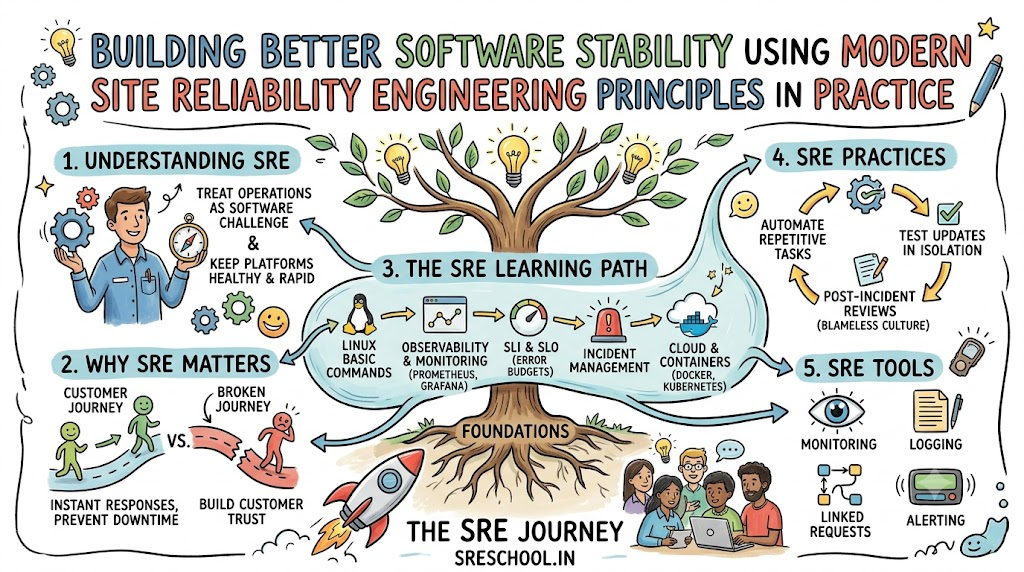
Introduction
Site Reliability Engineering helps keep your favorite websites running fast and without errors. We call this SRE for short. Modern apps break when many people use them at the same time. Because of this, software needs smart care to stay healthy. SRE combines writing code with managing big computer systems. An engineer writes software to fix computer problems automatically. This work stops video games and shopping sites from crashing. In this guide, you will learn the basics of SRE. You will see what engineers do each day. You will also discover important tools and smart habits. Next, you will explore learning paths and helpful certifications. Finally, platforms like SRESchool.in help curious students learn these key ideas with simple lessons.
What Is Site Reliability Engineering?
SRE means Site Reliability Engineering. The main purpose is to make computer systems work without stopping. Reliability simply means that a website works when you need it. When you click a button, the page should open right away. We call this system uptime. Uptime means the computers are on and healthy. Downtime means the website is broken and nobody can use it. SRE keeps uptime very high so users stay happy. It also protects system stability. Stability means the software does not crash under heavy use. Good speed is also a big part of stability. Nobody likes to wait for a slow video to load. SRE engineers use automation to handle boring computer chores. Automation means writing a script so machines do tasks alone. They also use monitoring tools to watch systems all day and night. Monitoring is like a digital doctor that checks the pulse of a computer.
Why Does SRE Matter?
People want their favorite apps to work all the time. But computer hardware can fail at any moment. Cables break, power goes out, and software bugs appear. When an app stops working, we call that downtime. Slow apps also make people angry. If an online store crashes, people cannot buy their food or clothes. This hurts business trust because customers walk away. Companies lose money every minute their app stays offline. SRE helps teams spot small errors before they grow into large disasters. SRE tools send fast alerts when something looks wrong. This quick notice helps engineers fix bugs right away. Then, the team studies the crash so it never happens again. They build strong safety nets around every piece of code. This careful work protects customer trust and keeps apps alive.
What Does An SRE Engineer Do?
An SRE Engineer protects apps from breaking. Think of them as firefighters and builders at the same time. They watch live screen dashboards that track computer memory and speed. If a server gets too hot, an alarm rings. The engineer answers this alert and finds the broken part. This work is called incident management. An incident is just an unplanned problem that hurts users. The engineer fixes the issue quickly to restore service. Next, they write code to automate the fix. If a task repeats, a computer should do it instead of a human. Engineers also plan system capacity. Capacity means having enough servers ready before big shopping days. They run tests in cloud systems to find weak spots. Most importantly, they team up with software developers to make apps safer. After every crash, they review the failure kindly and fix the root cause.
What Is SRE Training?
Good SRE Training teaches people how to keep big websites running. First, students learn Linux basics. Linux is a free computer operating system that runs most internet servers. Next, learners study monitoring and observability. Observability lets you look inside a system to see why it broke. Training also explains three important letters: SLI, SLO, and SLA. A Service Level Indicator, or SLI, measures real system behavior, like response speed. A Service Level Objective, or SLO, is the internal goal for that speed. A Service Level Agreement, or SLA, is a formal promise made to paying customers. If a team beats its SLO target, it earns an error budget. An error budget is room for small mistakes while trying new features. Students also practice incident management and cloud automation. Finally, they learn about containers and tools like Kubernetes that package apps neatly.
Why Consider SRE Certification?
An SRE Certification shows that you understand core reliability concepts. Taking an exam helps you organize your study time in a neat way. It gives you a clear checklist of important ideas to master. But a test paper does not replace real practice. Employers care most about your ability to solve real system crashes. Because of this, you should build small projects alongside your study. Try setting up a home server or fixing a broken website. You can also write scripts that test cloud networks. When you pair exam study with hands-on practice, you learn much faster. A certificate proves you know the words, while your projects prove you can do the work. Both parts work together to make you a confident engineer.
What Should An SRE Course Include?
A strong SRE Course gives you a step-by-step path to learn operations. Every stage builds on the one before it so you never feel lost.
| Course Stage | Topic Name | What You Learn |
| Stage 1 | SRE Basics | Learn core ideas, system uptime, and why reliability matters |
| Stage 2 | Linux Basics | Master command lines, file permissions, and server processes |
| Stage 3 | Monitoring and Alerts | Set up dashboards and create alarms that warn of system bugs |
| Stage 4 | SLIs and SLOs | Set service goals, track metrics, and manage your error budget |
| Stage 5 | Incident Response | Lead outages calmly, talk with users, and run blameless reviews |
| Stage 6 | Cloud and Containers | Package code with Docker and manage clusters using Kubernetes |
| Stage 7 | Task Automation | Write clean Python or Go scripts to do repetitive server work |
| Stage 8 | Infrastructure Code | Build cloud networks using code tools such as Terraform |
| Stage 9 | Reliability Projects | Build safe systems with backup plans and test failover switches |
| Stage 10 | Production Practice | Run real web traffic, inject fake faults, and measure recovery speed |
SRE Training In India
India has many talented software developers building tools for the world. Cloud adoption is growing very fast across banks, retail, and tech startups. Because of this growth, companies need workers who understand DevOps and site reliability. Many engineers work on remote global teams that support users across every time zone. These engineers must know how to build stable systems that never sleep. That requires deep practical knowledge of cloud platforms and code automation. Reading simple theory is not enough to run massive production systems. Engineers want career-focused training with real practice on live servers. SRESchool.in helps learners in India gain these practical reliability skills through structured lessons. This prepares engineers for top roles in modern cloud engineering.
SRE Tools
Engineers use specialized SRE Tools to inspect, run, and repair their applications. The right tool makes finding broken code much faster.
| Tool Area | What It Does | Example Use |
| Monitoring | Tracks system health | Check server memory and error counts |
| Logging | Records system events | Search error files to find the cause of a fault |
| Tracing | Tracks user requests | Find which database call makes a checkout slow |
| Alerting | Sends urgent warnings | Page an engineer when a server crashes |
| Infrastructure | Manages computer resources | Use Terraform to build fifty cloud servers at once |
| Containers | Packages applications | Use Kubernetes to run and restart web services |
SRE Best Practices
Reliability improves when teams follow tested SRE Best Practices every single day. First, set clear service goals so developers know what to aim for. Track useful metrics like response time, but ignore useless numbers. Next, write meaningful alerts so engineers only wake up for real emergencies. Reducing alert noise prevents tired engineers from missing big problems. Always automate repeated work to save time and stop human mistakes. Test every system change in a private test area before sharing it with users. Prepare for sudden outages by writing clear step-by-step guides called runbooks. When an outage ends, hold a post-incident review to learn from the failure. Never blame people for mistakes; fix the broken system design instead. Plan server capacity early so holiday traffic does not crash your store. Finally, clean up messy technical debt so your software stays simple and safe.
Real-Life Scenarios
- Sudden Traffic Spike: A movie ticket app goes live with sales for a blockbuster film. Thousands of fans open the app at once. The servers run out of memory, and pages slow down. The SRE system spots the traffic surge instantly. It automatically launches ten new cloud servers to share the load. The app stays fast, and users buy their tickets without errors.
- Bad Code Release: A developer pushes an update that contains a hidden software bug. The checkout button stops working on mobile phones. Tracing tools notice that checkout errors jumped from zero to twenty percent. The SRE deployment system detects this change right away. It rolls back the update to the old safe version within two minutes. Shoppers never notice the brief hiccup.
- Database Disk Full: An internal logging database fills up its hard drive overnight. Without room to write new records, the payment service stops answering requests. An automated cleanup script runs, but fails to free up space. The on-call SRE gets an alert, expands the cloud storage volume with one command, and restores full service. Later, the engineer creates a permanent job to clean old records weekly.
Common SRE Mistakes To Avoid
- Alerting on Everything: Sending an alert for minor warnings exhausts the team. Solution: Only send alerts for problems that directly hurt users.
- Blaming People for Outages: Yelling at an engineer makes people hide their mistakes. Solution: Run blameless reviews that focus on broken tools, not people.
- Ignoring Boring Manual Work: Doing the same chore by hand wastes valuable engineering hours. Solution: Spend half your work time writing code that automates repetitive tasks.
- Setting 100 Percent Uptime Goals: Making a system run without any downtime is too costly. Solution: Use an SLO like 99.9 percent so you have room to launch new updates.
- Skipping Backup Drills: Teams assume backups work until a real emergency hits. Solution: Test your backup restoration process on a test server every month.
- Testing Only in Production: Pushing unverified code directly to real users causes frequent outages. Solution: Run automated tests in a staging area before shipping changes.
- Missing Runbooks for Incidents: Panicking during an outage leads to poor fixes. Solution: Write clear guides that tell responders what commands to run.
- Ignoring Small Errors: Small warning signs often hide deep architectural bugs. Solution: Track error trends each week and repair weak components early.
Educational Support From SRESchool
SRESchool.in provides a clear path for anyone interested in Site Reliability Engineering Training. Beginners can explore the foundations of modern cloud systems without feeling overwhelmed. The platform organizes complex topics into manageable lessons that any student can follow. If you are preparing for a Site Reliability Engineering Certification, having structured study materials helps you master essential concepts. Learners can review an in-depth SRE Tutorial to understand how Linux, cloud networks, and observability work together. You can also explore how to use modern SRE Tools to detect system bugs quickly. Understanding core SRE Best Practices helps new engineers avoid common production mistakes. Whether you want an introductory SRE Course or advanced insights, the lessons explain real operational challenges simply. For professionals seeking SRE Training in India, the platform offers guided learning to help build practical confidence. This structured support helps any aspiring SRE Engineer gain the skills needed to maintain dependable systems.
SRE Learning Roadmap
- Learn: Study basic computer concepts, Linux commands, network rules, and coding with Python or Go.
- Practice: Set up small servers at home or in a free cloud account.
- Build: Create a sample web application and package it inside a container using Docker.
- Test: Break your application on purpose by cutting network connections or filling up the disk to see what happens.
- Improve: Add monitoring dashboards and write automation scripts that fix those broken parts without human help.
Frequently Asked Questions
1. What does an SRE engineer do every day?
An SRE engineer keeps websites running smoothly and safely. They watch system dashboards to spot errors before users notice them. When a server breaks, they help fix the problem right away. Next, they write software programs that handle boring chores automatically. They also work with software developers to make new applications stable, fast, and simple to repair.
2. Can a beginner learn Site Reliability Engineering?
Yes, any beginner can learn SRE with patient study. You do not need to know everything on your very first day. Start by learning basic Linux commands and simple Python coding. Next, learn how web browsers talk to internet servers. As your confidence grows, you can practice with cloud tools and monitoring systems using clear guides.
3. How is SRE different from DevOps?
DevOps is a team philosophy about building and shipping software quickly. SRE is a concrete way to practice that philosophy using software engineering tools. SRE defines clear rules for measuring uptime, handling crashes, and managing operational work. You can think of DevOps as the general goal and SRE as the specific rulebook used to reach it.
4. What are SLIs, SLOs, and SLAs?
An SLI is a number that measures system health, like page load speed. An SLO is the target goal your team wants to hit for that number. An SLA is a business contract with customers that promises a certain level of service. If you miss an SLA target, your company might have to return money to clients.
5. Why is 100 percent uptime impossible to reach?
Aiming for 100 percent uptime costs too much money and stops innovation. Every software update carries a tiny risk of failure. If you forbid all downtime, you can never release exciting new features to your users. SRE teams use error budgets instead. This small allowance lets teams build new things while keeping service safe and steady.
6. What programming languages do SRE engineers use?
Most SRE engineers write code in Python or Go. Python is very simple to read and works great for writing quick automation scripts. Go is very fast and powers popular cloud tools like Kubernetes and Docker. Some engineers also write Bash scripts to run quick maintenance commands directly on their Linux servers.
7. What is an error budget in SRE?
An error budget is the amount of downtime your system can have without making users mad. If your goal is 99.9 percent uptime, your error budget is 0.1 percent. You can spend this budget to push risky product updates. But if you burn through your budget, you must pause new releases and fix system bugs.
8. What happens during an incident post-mortem?
A post-mortem is a learning meeting held after an outage ends. The team maps out what happened, why it happened, and how they fixed it. SRE teams keep these meetings completely blameless. Nobody gets yelled at or punished for an honest error. Instead, the team updates their software and runbooks to prevent the same bug tomorrow.
9. Do I need to be a software developer first?
No, you do not need to work as a full developer first. Many engineers move into SRE from system administrator or technical support roles. However, you do need to learn basic coding along the way. Writing simple automation scripts is a core skill for the job. Learning to write clean code will make your daily work much easier.
10. What is observability in modern computer systems?
Observability means understanding the internal health of a system by looking at its external outputs. It relies on three main types of data: metrics, logs, and traces. Metrics show system numbers, logs record major events, and traces follow user requests across networks. Together, they help engineers find the root cause of weird software bugs quickly.
11. What is blameless culture in SRE?
A blameless culture means treating system failures as learning moments instead of human crimes. Humans make mistakes when tools allow them to make mistakes. If an engineer deletes a database, the real problem is a dangerous tool that lacked a safety check. Fixing the unsafe tool prevents other teammates from making that same mistake in the future.
12. How does SRE help companies save money?
SRE saves companies money by stopping costly system outages. When a shopping site stays online, customers can buy goods without seeing errors. SRE automation also handles boring server chores without requiring extra staff. Finally, capacity planning ensures companies only pay for the cloud servers they actually need, which keeps monthly infrastructure bills low.
Conclusion
Site Reliability Engineering keeps modern websites fast, dependable, and ready for users. It brings code and operations together to solve hard system problems. Instead of fixing the same errors by hand, engineers write software to run tasks automatically. Learning SRE opens doors to fun, impactful careers in the tech world. You can start small by studying Linux, simple coding, and basic system metrics. Next, build your own test projects and practice finding bugs. Platforms like SRESchool.in provide clear learning materials that help you build these skills step by step. With steady practice and simple habits, anyone can learn to run reliable cloud systems.
Leave a Reply