Essential Steps for Deciding Between Buying Equipment or Hiring Professional Local Pilots

October 6, 2026 · 12 reads
Introduction
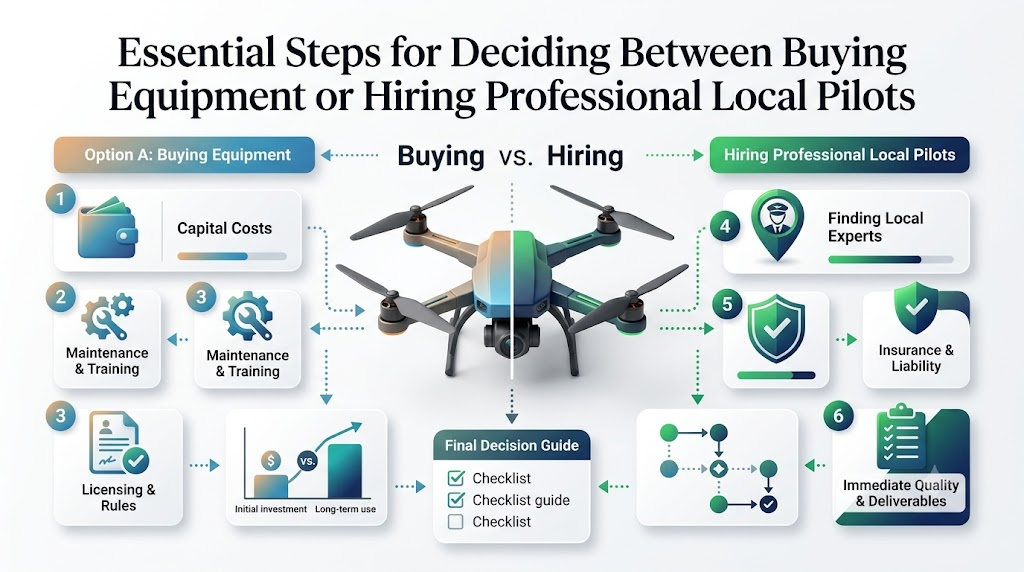
People face hundreds of flying gadgets on store shelves every single day. Tiny pocket crafts zip over green grass for simple amusement. Heavy carbon frames carry massive survey lenses across busy building zones. Your real project must steer every choice you make here. Clear drone reviews show how these machines handle real wind and dust. A direct drone comparison places two flyers head-to-head on key traits. Detailed drone specifications list true motor limits, battery minutes, and camera sensors. Sometimes purchasing expensive machinery makes very little sense for a quick job. Smart business operators book dedicated drone services to finish hard work on time. An online hub called DronesBee organizes buyer guides and connects project managers with qualified teams. This simple guide helps you pick good tools and save precious funds.
Start With Your Main Drone Goal
Pick your exact task before you browse any shop catalogs. A travel blogger demands a featherweight pocket craft for quick family clips. A feature filmmaker needs steady cinematic lenses that track rapid action smoothly. Land surveyors need sharp orthomosaic map views with crisp elevation figures. Roofers seek strong zoom lenses to find broken slate tiles safely. Crop producers require big chemical tanks to nourish vast crop acres. General contractors demand weekly site photos to track crew progress across dirt lots. Novices simply desire easy Sunday fun in open backyards. No single aerial craft handles all these diverse chores with equal skill. State your core target clearly before you hand over any cash.
What to Check in Drone Reviews
Honest pilot reports show how machines hold up under real work conditions. Study image sensors, shutter modes, and color profiles with high care. Check real flight minutes against windy conditions outdoors. Heavy airframes encounter strict federal permit rules in many regions. Check remote signal links through trees and light building walls. Sturdy safety sensors halt forward motion before blades hit backyard fences. Study companion mobile apps for easy flight planning and smooth video transfers. Confirm that the builder sells quick replacement propellers and motor arms. Search for frank discussions about product flaws alongside glowing praise.
Make a Simple Drone Comparison
Set two or three candidate aircraft side by side on paper. Low retail price tags frequently hide poor safety gear and fragile plastic joints.
| Factor | What to Check | Why It Matters |
| Camera | Sensor dimension and megapixel count | Sharp pictures show vital project details |
| Flight time | Real air minutes per pack | Longer sessions cut costly landing pauses |
| Weight | Total grams on the scale | Light builds avoid heavy legal paperwork |
| Range | Controller signal reach | Solid links stop dangerous runaway flights |
| Safety | Crash avoidance radar eyes | Automatic stops prevent expensive damage |
| Support | Repair parts and factory care | Fast fixes keep operations running smoothly |
| Price | Complete package expense | Smart choices protect your operating cash |
Calculate total operating bills across your initial calendar year. Extra flight packs, rugged cases, and spare blades raise startup expenses. Clean side-by-side charts protect your bank balance from nasty surprises.
Finding the Best Drones for Your Job
The best drones solve your specific workplace hurdles without extra fuss. Eager beginners should choose cheap models with full prop ring guards. Outdoor travelers love folding wings that slip right into tiny daypacks. Commercial filmmakers select three-axis mechanical gimbals for buttery smooth motion shots. Survey technicians need RTK satellite chips for pinpoint land measurements. Facility inspectors demand tough housings that carry sensitive thermal heat cameras. Plant managers buy giant multi-rotor giants with high-pressure spray booms. Always pair aircraft traits with your actual field assignments.
When You Need Drone Services
Owning high-end flight gear creates substantial ongoing work for small shops. Advanced aircraft carry hefty price tags and demand strict storage rules. Staff members spend valuable weeks studying basic manual flight stick skills. Batteries require frequent health checks, cycling, and climate-controlled storage boxes. Operators must carry active commercial licenses and expensive damage insurance policies. Booking experienced specialists makes more economic sense for seasonal or occasional tasks. Licensed operators arrive with modern tools and carry full risk coverage. DronesBee pairs your business with ready professionals in your area.
How to Find Drone Pilots Near Me
Locate trained flight professionals right within your home county. Search for drone pilots near me through verified online directories. Demand to inspect the operator’s current commercial pilot certificate. Confirm active liability insurance that covers ground damage and injury. Review previous photo albums, 3D surface models, and thermal scans. Verify that the crew understands regional air traffic limits near local landing strips. Top pilots craft thorough emergency flight plans before turning on their motors. Trustworthy contractors provide fixed written estimates before launch day arrives. Reject any crew that flies commercial jobs without formal insurance documents.
Aerial Photography Services
High-altitude visual assets make commercial properties pop off computer screens. Real estate brokers hire aerial photography services to close property deals quickly. Sky perspectives reveal property borders, tree cover, and neighborhood street connections. Resort managers display scenic ocean views and swimming pools to attract vacationers. Highway builders record earthwork progress to reassure financial backers every single week. Cinema crews film dynamic vehicle chase scenes across wide mountain curves. Superior visual media requires creative pilot composition alongside high-resolution camera glass.
Drone Surveying Services
Modern surveyors map vast topography directly from clear blue skies. Drone surveying services replace exhausting ground treks across rough brush. An unmanned craft flies precise back-and-forth grid routes over open earth. The system snaps thousands of overlapping pictures across every single acre. Specialized desktop software stitches these separate images into rich point-cloud models. Construction foremen use these digital surfaces to calculate soil piles in minutes. Field crews finish large land maps in mere hours rather than painful weeks.
Professional Drone Work Comparison
Commercial flight paths require distinct equipment packages and operator skills.
| Service Type | Key Equipment Used | Main Benefit Delivered |
| Aerial Photos | Large image sensors and steady gimbals | Stunning visual assets for commercial sales |
| Land Surveying | RTK satellite units and mapping suites | Precise spatial data for engineering teams |
| Roof Inspection | High-magnification zooms and heat lenses | Fast hazard checks without rickety ladders |
| Crop Spraying | Heavy-lift airframes and liquid booms | Fast, even field treatment on muddy ground |
Drone Inspection Services
Climbing steep ladders introduces severe injury hazards for maintenance crews. Drone inspection services protect human technicians by keeping their boots on flat soil. A robotic craft circles tall wind turbines, power pylons, and steep roof decks. Highway bridges and utility solar plants get quick visual health checks. High-magnification telephoto lenses detect loose iron bolts and hairline masonry fissures. Thermal heat sensors identify trapped water beneath flat commercial roof membranes. Flying sensors cut inspection hours while protecting worker safety on dangerous jobs. Human mechanics still climb up later to replace worn steel parts.
Agricultural Drone Services
Modern growers use aerial technology to boost overall crop yields. Agricultural drone services track vast plant rows with multispectral light sensors. These specialized lenses catch nitrogen hunger long before leaves turn pale yellow. Early pest alerts give farmers time to protect vulnerable fruit clusters. Massive spray copters hover smoothly over damp fields after heavy rain showers. They apply liquid nutrition directly to struggling crop zones with great accuracy. Targeted spraying trims input costs while keeping excess chemicals out of local groundwater.
Real-Life Scenarios
- A retail strip mall manager needs roof leak checks after a violent storm. A hired pilot flies a thermal camera over the flat roof in forty minutes. The heat scan highlights wet insulation under two air handlers, allowing targeted patches.
- An organic grape vineyard battles fungal rot across steep hillside terraces. A commercial spray rig delivers organic fungicide directly onto damp canopy leaves. The farmer finishes the steep twenty-acre hill without driving heavy tractors across slick mud.
- A regional land developer prepares sixty acres of rolling forest for home lots. A survey crew launches a mapping drone to record accurate topographic contour lines. The engineering team receives full CAD elevation drawings within forty-eight hours.
Common Mistakes to Avoid
- Purchasing complex machines without a clear task: People spend large sums on gear they never unpack. Define your exact application before buying.
- Neglecting federal airspace limits: Flying near landing strips causes severe legal trouble. Check airspace charts before every takeoff.
- Operating with only one battery pack: Air sessions end within thirty minutes. Carry three fresh battery sets to field sites.
- Launching into strong gusty winds: High gusts blow small aircraft off course. Track surface wind speeds using weather apps.
- Traveling without replacement propellers: Small plastic blades crack on dry twigs. Store multiple spare blade sets inside your carry case.
- Employing uninsured hobby pilots: Unlicensed flyers risk heavy municipal fines and crash damage. Demand formal insurance proof before booking services.
- Forgetting long-term repair budgets: Moving motor parts wear out over months of hard work. Reserve extra cash for routine motor upkeep.
- Believing packaging flight claims: Builders test battery endurance inside windless test rooms. Budget for shorter flight windows during outdoor operations.
How DronesBee Can Help
DronesBee simplifies your aerial journey from initial study to field execution. The platform organizes detailed drone reviews alongside side-by-side comparison tables. You can review authentic drone specifications without sorting through confusing technical jargon. The portal also features fresh industry announcements and practical buying instructions. When your company requires hands-on flight help, DronesBee pairs you with certified local contractors. You can gather competitive quotes for photography, aerial mapping, and roof scans. The site lets you study hardware features first and book skilled help with complete confidence.
Frequently Asked Questions
1. Can a beginner fly a camera drone safely?
First-time pilots can control modern consumer drones without fear. Onboard satellite sensors hold the aircraft steady against gentle outdoor breezes. The system stops forward movement and hovers in place whenever your hands leave the control sticks. New flyers should practice basic maneuvers over soft grass in wide empty parks on calm mornings.
2. How long does a normal drone battery last?
Standard consumer flight batteries deliver twenty to thirty minutes of active sky time. Cold morning air, strong wind gusts, and aggressive throttle habits drain lithium cells rapidly. Heavy camera payloads also cut total endurance. Smart pilots pack several pre-charged batteries to complete assignments without lengthy charging delays at the job site.
3. Do I need a license to fly for fun?
Recreational flyers in most jurisdictions must complete a short, free online safety quiz. Aircraft weighing over 250 grams require official registration with civil aviation authorities before outdoor flights. Keep your registration paper handy during trips and respect privacy rules to keep local skies open for everyone in the neighborhood.
4. What does return to home mean?
Autonomous return logic acts as a vital safety net for every pilot. The aircraft records satellite coordinates for its launch pad before lifting off the grass. If your remote transmitter loses connection or battery levels drop dangerously low, the craft climbs to a safe altitude and flies straight back to the landing mark.
5. Can drones fly safely in the rain?
Standard commercial drones carry open motor vents that allow water drops inside delicate internal circuits. Moisture triggers electrical short circuits, which cause sudden mid-air power failures. Wet spinning blades also lose lift capacity in dense air. Ground your flight gear immediately whenever rain, dense fog, or wet snow starts falling.
6. Why should I hire a pilot instead of buying gear?
Booking a certified pilot saves capital funds on occasional business tasks. Professional operators carry official commercial credentials, comprehensive liability coverage, and enterprise sensors. They gather clean, usable data without costly procedural mistakes. You skip expensive machinery outlays, ongoing battery care, software subscription fees, and time-consuming licensing classes.
7. What are drone specifications?
Technical specifications provide exact engineering numbers for an aircraft. These data sheets explain motor thrust, top horizontal speed, maximum payload limit, sensor dimensions, and battery capacity. Checking these metrics helps buyers identify true operational boundaries, preventing expensive hardware mistakes before placing an order.
8. How high can a drone legally fly?
Aviation regulators generally restrict unmanned flights to 400 feet above ground level. This safety ceiling maintains safe vertical separation between small recreational craft and low-flying manned aircraft. Pilots must maintain direct line-of-sight visual contact with their flying machines throughout the entire mission duration.
9. What is an obstacle avoidance sensor?
Collision avoidance systems rely on miniature optical cameras, infrared sensors, or tiny radar units mounted around the chassis. These digital eyes scan for tree limbs, utility cables, and concrete walls. The onboard flight computer stops the craft automatically when hazards appear, preventing painful structural crashes during tight indoor or forest maneuvers.
10. Can drones see through roof tiles?
Standard optical lenses cannot peer through dense architectural roofing materials. Thermal infrared sensors, however, record subtle surface temperature variations across shingle decks. Moisture trapped beneath roofing membranes holds solar warmth longer into the evening. Technicians spot these thermal signatures on their screens to pinpoint leaks without pulling up sound tiles.
11. What is the difference between a consumer and commercial drone?
Consumer aircraft are lightweight, quiet, and designed for family vacation clips or hobby flights. Commercial platforms use reinforced industrial airframes built for punishing work shifts. They carry heavy survey cameras, multispectral crop sensors, or large liquid delivery tanks. Industrial units cost substantially more money and require professional operational knowledge.
12. How do I choose between two similar drones?
Start by defining your primary commercial deliverable. Prioritize large camera sensors if visual quality drives your business income. Evaluate real battery endurance, wind tolerance ratings, and spare component availability. Read real feedback from active operators who run both models daily. Select the system that fulfills your work obligations within your realistic budget.
Conclusion
Matching aerial tools to specific tasks saves valuable time and hard-earned money. Define your performance goals, project deadlines, and real skill limits before buying gear. Check objective reviews and balance essential capabilities against real costs, including extra batteries and transport cases. Follow national airspace rules to keep flights safe for everyone on the ground. When complex mapping or high-risk industrial inspections demand specialized tools, hire a certified local pilot. Marketplaces like DronesBee streamline your technical research and help you hire dependable aerial partners. Choose the drone for the job, not just the drone with the biggest feature list.
Leave a Reply