Modern Enterprise Automation Standards Defined Through The DevOps Certified Professional (DCP)

September 15, 2026 · 16 reads
Introduction
DevOps Certified Professional (DCP) represents an end-to-end credential designed to validate practitioner-grade capabilities across infrastructure automation, continuous delivery, and operational reliability. This guide addresses software developers, platform operators, system administrators, and technology leads who want to move beyond superficial tool knowledge into engineering resilient software delivery pipelines. Modern organizations demand integrated teams capable of bridging code commit and cloud runtime, making systematic proficiency essential. Within cloud-native deployments, platform engineering practices, and enterprise scale, this validation certifies your ability to eliminate delivery bottlenecks and manage production systems safely. Reading this roadmap will clarify whether the credential matches your background, how it advances your day-to-day competence, and the exact sequence required to maximize career progression.
What is the DevOps Certified Professional (DCP)?
DevOps Certified Professional (DCP) represents an industry-benchmarked standard establishing practical operational excellence across modern enterprise infrastructure systems. It exists to solve the disconnect between classroom theoretical learning and the complex, break-fix realities of high-throughput production software delivery platforms. Rather than testing passive memorization of documentation, the curriculum concentrates entirely on real-world engineering workflows, scalable orchestration, automated testing barriers, and infrastructure state management. Modern enterprise engineering teams rely on consistent practices across continuous integration pipelines, multi-cloud hosting, configuration automation, and dynamic observability stacks. Achieving this validation proves an engineer understands systems architecture, continuous improvement, and the disciplined execution of release cycles within modern technology environments.
Who Should Pursue DevOps Certified Professional (DCP)?
Infrastructure engineers, system administrators, site reliability engineers, and backend software developers seeking structured career growth derive immediate benefits from this professional program. Quality assurance specialists, cloud practitioners, database administrators, and cyber defense operators transitioning into continuous delivery workflows will find the curriculum directly applicable to operational routines. Early-career developers acquire fundamental clarity regarding enterprise production architectures, while senior engineers systematically validate their distributed systems knowledge against structured architectural benchmarks. Engineering directors, delivery managers, and enterprise architects require this foundational comprehension to guide platform modernizations, allocate project resources, and manage agile team transitions. The operational principles covered remain globally recognized across North America, Europe, the Asia-Pacific region, and the rapidly growing engineering ecosystem in India.
Why DevOps Certified Professional (DCP) is Valuable
Enterprise hiring managers continuously seek engineers who possess integrated, end-to-end delivery experience rather than disconnected expertise in isolated utility frameworks. Tool stacks evolve rapidly across script utilities, deployment agents, and container runtimes, but core delivery engineering concepts retain long-term systemic value throughout an entire technology career. Earning this validation proves you grasp immutable infrastructure, container management, zero-downtime blue-green strategies, and enterprise deployment patterns that persist across shifting commercial software trends. The return on educational time invested manifests in reduced production outage incidents, faster internal pipeline delivery rates, and demonstrable ownership over deployment architectures. Organizations consistently reward practitioners who can stabilize operational delivery pipelines, lower infrastructure costs, and implement self-healing cloud workloads.
DevOps Certified Professional (DCP) Certification Overview
The program is delivered via the official portal at DevOpsSchool and is directly hosted by the DevOpsSchool platform ecosystem. Candidates navigate a curriculum evaluated through rigorous performance testing, hands-on lab execution, and scenario assessments modeled after high-stakes enterprise infrastructure environments. The structural ownership maintains continuous industry relevance through updates aligned with platform orchestration models, cloud-native frameworks, and automated compliance regulations. Candidates take complete responsibility for configuring live runtime systems, provisioning remote clusters, resolving operational delivery failures, and setting up automated telemetry collectors. By blending structured theoretical frameworks with intensive hands-on lab evaluations, the assessment model measures actual technical execution rather than arbitrary question memorization.
DevOps Certified Professional (DCP) Certification Tracks & Levels
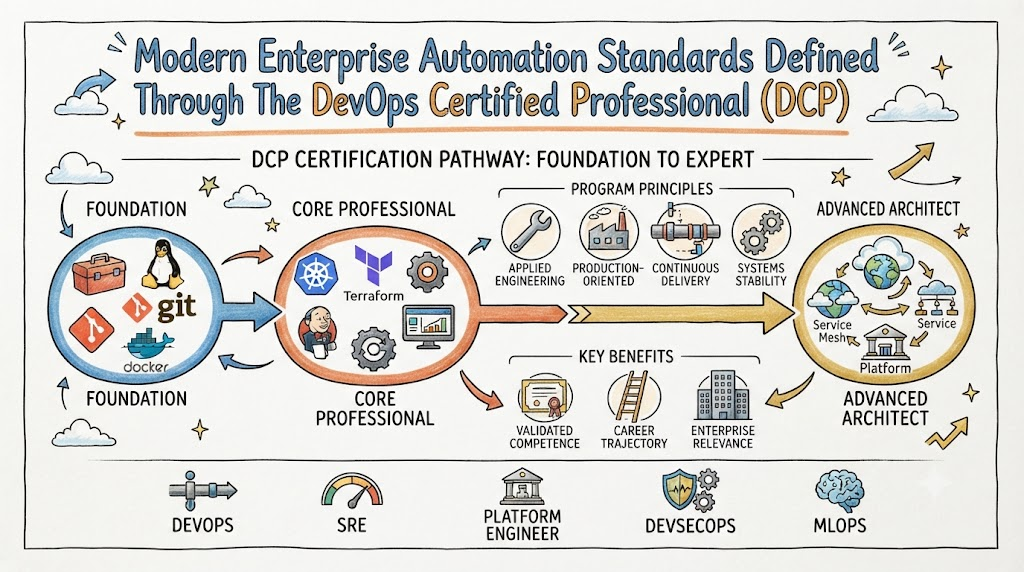
The curriculum is organized across foundation, professional, and advanced tiers to accommodate varied professional experience profiles and career trajectories. The foundation level introduces developers and operations staff to containerization concepts, versioning controls, basic continuous integration pipelines, and declarative deployment structures. The professional level concentrates on automated infrastructure provisioning, multi-stage testing setups, zero-downtime rolling upgrades, configuration management, and centralized cluster operations. At the advanced level, engineers master self-healing distributed platforms, multi-region failover automation, enterprise policy enforcement, and infrastructure cost transparency. Specialized career paths allow experienced engineers to branch smoothly into site reliability engineering, security-first compliance, data pipeline delivery, or financial platform governance.
Complete DevOps Certified Professional (DCP) Certification Table
| Track | Level | Who it’s for | Prerequisites | Skills Covered | Recommended Order |
| Core Systems Delivery | Foundation | Junior engineers, sysadmins, testers | Basic Linux and Git knowledge | Shell scripting, Docker, CI concepts | First |
| Platform Engineering | Professional | DevOps engineers, cloud developers | 1+ years systems experience | Kubernetes, Terraform, Jenkins, Ansible | Second |
| Reliability Engineering | Advanced | Senior operators, system architects | Professional level or SRE context | Chaos testing, distributed tracing, SLOs | Third |
| Security Operations | Professional | Security engineers, compliance leads | Core systems pipeline awareness | SAST, DAST, secrets rotation, policy enforcement | Fourth |
| Operational Intelligence | Advanced | Infrastructure leads, platform heads | Solid operational background | Automated remediation, telemetry, capacity planning | Fifth |
Detailed Guide for Each DevOps Certified Professional (DCP) Certification
DevOps Certified Professional (DCP) – Foundation Level
What it is
This entry certification establishes and validates essential fluency in foundational delivery automation, container basics, and source control governance. It ensures candidates comprehend modern operational lifecycles and modern automated delivery concepts without unnecessary architectural abstractions.
Who should take it
Junior software developers, manual testers, traditional systems administrators, and recent technical graduates aiming to pivot into cloud automation roles. Candidates should possess a basic familiarity with command-line interfaces and elementary operating system fundamentals.
Skills you’ll gain
- Linux shell automation, process handling, and permissions
- Git branch management, rebasing, and merge resolution
- Container image building, layering, and lightweight optimization
- Basic continuous integration pipelines using declarative automation scripts
- System monitoring fundamentals and host-level log extraction
Real-world projects you should be able to do
- Containerize a multi-tier web application using optimized, lightweight base images
- Construct an automated build script triggered directly by repository code commits
- Provision local development runtimes using isolated, reproducible container definitions
Preparation plan
- 7–14 Days: Focus on intense Linux command-line exercises, shell scripting patterns, and basic Docker build instructions.
- 30 Days: Practice daily Git team collaboration workflows and establish local build engines to automate basic web applications.
- 60 Days: Build complete local applications, automate testing, and practice manual diagnostic reviews of failed build executions.
Common mistakes
- Ignoring Linux permissions, file systems, and process handling fundamentals
- Relying exclusively on graphical user interfaces instead of native terminal command operations
- Memorizing command syntax without understanding how containers isolate system processes
Best next certification after this
- Same-track option: DevOps Certified Professional – Professional Level
- Cross-track option: DevSecOps Certified Practitioner
- Leadership option: Agile Delivery and Continuous Integration Team Lead
DevOps Certified Professional (DCP) – Professional Level
What it is
This credential validates enterprise-level engineering capabilities in infrastructure as code, container orchestration, configuration drift control, and enterprise pipeline management. It certifies a practitioner’s readiness to administer production environments and build reliable continuous deployment workflows.
Who should take it
Practicing DevOps engineers, cloud administrators, site reliability engineers, and backend developers with at least one to two years of hands-on platform delivery experience. It suits engineers tasked with maintaining live cloud resources and deployment automation.
Skills you’ll gain
- Infrastructure provisioning using declarative infrastructure-as-code patterns
- Kubernetes cluster deployment, service networking, and workload lifecycle management
- Multi-stage continuous integration and delivery pipelines with automated rollback safety
- Configuration automation, idempotent provisioning, and centralized node fleet management
- Centralized telemetry, logging infrastructure, and basic incident alerts
Real-world projects you should be able to do
- Provision a complete, secure cloud virtual network and managed compute instances using declarative code
- Deploy an enterprise microservices workload onto a container orchestration cluster with health checks and auto-scaling
- Design an automated delivery pipeline featuring automated canary testing and zero-downtime deployment strategies
Preparation plan
- 7–14 Days: Focus on infrastructure-as-code state management, container orchestration manifests, and pipeline declaration syntax.
- 30 Days: Build end-to-end deployment workflows combining configuration tools, container orchestration, and multi-branch source pipelines.
- 60 Days: Simulate realistic production failure modes, resolve complex cluster networking problems, and refine deployment runbooks.
Common mistakes
- Storing hard-coded secrets or credentials directly in code repositories and pipeline definitions
- Treating container clusters like traditional virtualization instances instead of immutable runtime engines
- Failing to write modular, reusable, and tested infrastructure configuration files
Best next certification after this
- Same-track option: DevOps Certified Professional – Advanced Level
- Cross-track option: Site Reliability Engineering Certified Specialist
- Leadership option: Platform Engineering Manager and Operations Lead
DevOps Certified Professional (DCP) – Advanced Level
What it is
This level validates advanced systems architecture capabilities, enterprise platform resilience, multi-region automated delivery, and deep platform engineering practices. It confirms that the holder can design self-healing production topologies that withstand substantial scale and component failures.
Who should take it
Senior platform engineers, principal systems architects, and infrastructure leads with extensive enterprise production experience. It is designed for senior engineers responsible for organizational system availability, platform tool standardization, and infrastructure resilience.
Skills you’ll gain
- Multi-cluster service mesh management and advanced traffic manipulation
- Dynamic enterprise compliance enforcement and policy-as-code implementation
- Chaos engineering experimentation, resilience verification, and distributed failure injection
- Advanced distributed tracing, latency profiling, and dynamic performance bottleneck identification
- High-availability disaster recovery automation and multi-region state synchronization
Real-world projects you should be able to do
- Implement an enterprise-wide policy-as-code framework preventing non-compliant cloud resource provisioning
- Execute controlled chaos experiments across container clusters to validate automated failover routines
- Construct a multi-tenant platform interface abstracting deployment complexities for software development teams
Preparation plan
- 7–14 Days: Review advanced cluster networking, traffic management, and policy engine syntax.
- 30 Days: Implement service meshes, build custom pipeline security gates, and run scheduled chaos experiments in staging.
- 60 Days: Design comprehensive infrastructure architectures, conduct fault tolerance benchmarks, and document failure remediation.
Common mistakes
- Overcomplicating deployment architectures without clear operational requirements
- Neglecting edge cases in distributed database state management during regional failovers
- Focusing exclusively on automated deployment while ignoring continuous observability and platform maintenance
Best next certification after this
- Same-track option: Enterprise Platform Architect Certification
- Cross-track option: Cloud Financial Operations and Cost Architect
- Leadership option: Director of Platform Engineering and Operations
Choose Your Learning Path
DevOps Path
The dedicated DevOps path concentrates on shortening the systems development lifecycle while delivering features, fixes, and updates in close alignment with business objectives. Practitioners master source code collaboration, automated unit testing validation, artifact repository governance, and automated cloud delivery pipelines. The curriculum emphasizes eliminating deployment bottlenecks and turning manual administrative processes into resilient, automated code artifacts. Completing this path positions you to manage continuous integration servers, package production-grade binaries, and maintain high-speed delivery velocity across cross-functional engineering organizations.
DevSecOps Path
The DevSecOps track ensures security practices, dependency vulnerability auditing, and policy governance integrate directly into every deployment pipeline phase. Engineers master automated static code vulnerability scanning, dynamic application testing, container image security checks, and secret life-cycle management. The curriculum removes historical frictions between security teams and development velocity by embedding compliance gates directly into deployment automation workflows. Choosing this specialization prepares you to build hardened deployment platforms that automatically prevent insecure architectures from entering production environments.
SRE Path
The Site Reliability Engineering track shifts primary operational focus toward maintaining system stability, high availability, latency management, and comprehensive observability. Engineers learn to establish meaningful Service Level Indicators, Service Level Objectives, error budget frameworks, and automated incident triage processes. The training emphasizes writing production software that automates manual operational tasks, eliminates repetitive platform management, and stabilizes complex distributed services. This path is ideal for engineers who enjoy diagnosing complex distributed systems failures, conducting blameless retrospectives, and engineering self-healing platforms.
AIOps Path
The AIOps path focuses on applying machine learning algorithms, statistical telemetry analysis, and event correlation engines to modern operational infrastructure platforms. Engineers learn to aggregate multi-source log telemetry, reduce operational alert fatigue, identify anomalies before outages occur, and automate root-cause discovery. The specialization bridges the gap between infrastructure metrics and algorithmic diagnostics, providing actionable visibility across complex multi-cloud environments. Practitioners who master this discipline help engineering teams anticipate operational failures, optimize compute resources, and orchestrate automated incident responses.
MLOps Path
The MLOps track addresses the technical challenges of moving artificial intelligence and machine learning models from experimentation into scalable production runtimes. Engineers master automated feature storage architectures, data pipeline continuous integration, automated model training triggers, and continuous model performance monitoring. The curriculum emphasizes artifact versioning, dynamic GPU cluster orchestration, and drift detection across live inference workloads. Choosing this track equips engineers to build reliable automated deployment foundations for production artificial intelligence systems.
DataOps Path
The DataOps specialization applies agile continuous delivery disciplines, automated testing, and infrastructure monitoring directly to modern enterprise data pipelines. Practitioners learn to orchestrate data transformation pipelines, automate schema migration checks, monitor data quality degradation, and provision isolated data testing sandboxes. This path breaks down operational silos between data science, business analytics, and central platform engineering teams. Mastering DataOps enables you to deliver trustworthy, high-availability data infrastructure that complies with corporate governance and security standards.
FinOps Path
The FinOps path introduces operational financial accountability to cloud infrastructure management, resource allocation, and architectural provisioning decisions. Engineers learn to monitor cloud consumption patterns, attribute infrastructure expenses across development teams, implement automatic idle-resource cleanups, and manage spot instances. The curriculum brings together engineering, finance, and operational business leaders around transparent unit economic metrics. Pursuing this path establishes your ability to design cost-effective cloud architectures and control corporate infrastructure expenditure without sacrificing operational performance.
Role to Recommended DevOps Certified Professional (DCP) Certifications
| Role | Recommended Level | Core Focus Area | Primary Target Skills |
| DevOps Engineer | Professional Level | End-to-end automation pipelines | Kubernetes, Terraform, CI/CD design |
| SRE | Advanced Level | Reliability, latency, fault tolerance | SLOs, chaos engineering, observability |
| Platform Engineer | Advanced Level | Internal developer platform tooling | Multi-tenancy, service mesh, policy as code |
| Cloud Engineer | Professional Level | Cloud platform infrastructure delivery | IaC, cloud networking, compute lifecycle |
| Security Engineer | Professional Level | Pipeline compliance, secure runtime | SAST/DAST, secrets, vulnerability scanning |
| Data Engineer | Professional Level | Data pipeline workflow orchestration | Pipeline automation, schema verification |
| FinOps Practitioner | Professional Level | Cloud economics, waste remediation | Tagging governance, cost allocation |
| Engineering Manager | Foundation Level | Systems delivery governance, metrics | DORA metrics, platform velocity, culture |
Next Certifications to Take After DevOps Certified Professional (DCP)
Same Track Progression
Once you complete the core curriculum, deep technical specialization within cloud-native architectures represents the most direct professional progression. Engineers should pursue advanced container networking credentials, complex multi-cloud infrastructure orchestration specializations, and deep distributed systems architecture validations. Expanding within the core track allows you to progress toward Principal Infrastructure Engineer or Lead Platform Architect roles. This path reinforces your ability to design resilient corporate infrastructure, establish technical delivery roadmaps, and standardize technology choices across multiple engineering units.
Cross-Track Expansion
Broadening your technical scope into adjacent engineering operational practices makes you an exceptionally versatile technology asset for any enterprise. Practitioners who master continuous delivery benefit substantially by acquiring formal certifications in DevSecOps pipeline automation, SRE observability, or cloud cost governance. Integrating security controls or operational financial accountability directly into existing deployment pipelines elevates your strategic value across modern cross-functional teams. This cross-disciplinary approach ensures you can navigate changing corporate engineering priorities and bridge communication divides between specialized platform teams.
Leadership & Management Track
For senior practitioners transitioning from pure hands-on keyboard execution to team direction, formal leadership certifications provide the required project, organizational, and people competencies. Relevant next steps include enterprise agile leadership certifications, engineering management credentials, and technology delivery strategy specializations. These curricula teach candidates how to measure organizational delivery velocity using industry-standard DORA metrics, balance technical debt against business roadmap execution, and mentor high-performing operations teams. This path is suited for engineers aiming to become Engineering Managers, Directors of Infrastructure, or Heads of Platform Engineering.
Training & Certification Support Providers for DevOps Certified Professional (DCP)
DevOpsSchool
DevOpsSchool provides comprehensive educational ecosystems dedicated to modern software operations, container ecosystems, and cloud platform delivery. Their curriculum combines structured conceptual frameworks with intensive hands-on lab environments simulating realistic enterprise production environments. Instructors possess extensive industry backgrounds, mentoring students through real-world deployment troubleshooting, pipeline security challenges, and automated cluster administration. The platform serves practicing engineers seeking verified technical competence and organizations implementing infrastructure modernization initiatives. With flexible schedules, dedicated lab resources, and continuous curriculum updates, DevOpsSchool remains an established provider for candidates preparing for professional platform engineering assessments and long-term career advancement.
Cotocus
Cotocus operates as an enterprise-focused IT training and consulting organization specializing in continuous integration workflows, cloud modernizations, and platform engineering methodologies. The organization focuses on real-world implementation techniques, offering practical enterprise training that matches modern workplace expectations. Their instructors walk candidates through complex container orchestrations, immutable infrastructure patterns, and deployment safety mechanisms across various cloud providers. Cotocus provides corporate groups and independent engineers with structured learning paths, architectural coaching, and technical mentorship. Their intensive labs and scenario-driven exercises make them an effective educational option for professionals seeking measurable improvements in daily operational delivery speed.
Scmgalaxy
Scmgalaxy is a long-standing knowledge community and educational hub dedicated to software configuration management, build automation, continuous delivery, and systems operations. It provides extensive repositories of technical guides, industry tutorials, open-source operational tools, and structured preparation resources. The platform’s training programs emphasize real-world systems management, teaching practitioners how to automate release cycles, manage legacy infrastructure transitions, and establish modern delivery tooling. Supported by a broad community of practicing DevOps specialists, Scmgalaxy offers practical technical guidance. Its educational materials suit engineers seeking grounded operational perspectives and actionable insights to resolve day-to-day deployment challenges.
BestDevOps
BestDevOps functions as an informational and training platform designed to simplify complex cloud-native architectures, container toolchains, and delivery pipeline frameworks. The site curates industry best practices, implementation guides, and structured training materials tailored to emerging enterprise delivery standards. Their educational programs focus on practical implementation, helping engineers build repeatable deployment patterns, maintain observability stacks, and eliminate fragile manual operational procedures. With clean instructional content and direct architectural walkthroughs, BestDevOps guides students through the practical skills required for platform operations. It serves as a dependable educational foundation for practitioners aiming to advance their systems engineering careers.
devsecopsschool.com
devsecopsschool.com focuses exclusively on integrating proactive security controls, vulnerability management, and regulatory compliance into continuous delivery pipelines. The platform provides hands-on technical training covering secret management, static and dynamic application security analysis, and container runtime defense. The curriculum demonstrates how to automate security validation without slowing down rapid deployment workflows, addressing friction between security teams and development velocity. Engineering professionals learn to enforce security as code, automate audit compliance, and detect cloud misconfigurations early. The platform is an essential destination for infrastructure and security professionals striving to secure modern continuous deployment pipelines.
sreschool.com
sreschool.com provides specialized technical training dedicated to the principles of Site Reliability Engineering, distributed systems resilience, and production availability governance. The platform teaches engineers how to define measurable service level objectives, manage error budgets, build distributed tracing systems, and organize blameless post-incident reviews. Its educational offerings emphasize writing operational software that automates manual platform maintenance and manages production emergencies methodically. Students gain practical experience diagnosing real-world infrastructure failures, managing incident bridges, and tuning high-throughput platform architectures. It remains a targeted educational provider for engineers transitioning into modern high-scale site reliability and operational stability roles.
aiopsschool.com
aiopsschool.com delivers advanced technical training focused on applying artificial intelligence, telemetry stream analytics, and machine learning models to enterprise infrastructure operations. The academy instructs engineers on aggregating massive volumes of multi-source telemetry data, automating root-cause discovery, and eliminating operational alert noise. By mastering proactive anomaly detection and algorithmic cluster remediation, students learn to build platforms that fix operational issues before outages disrupt end users. The platform bridges the divide between machine learning data pipelines and day-to-day infrastructure systems management. It is designed for forward-looking platform engineers and cloud architects building self-healing runtime systems.
dataopsschool.com
dataopsschool.com specializes in adapting automated continuous integration, delivery workflows, and testing rigor to enterprise data engineering and big data analytics. The institute offers structured courses covering data pipeline orchestration, automated schema migration validation, data hygiene checks, and isolated testing sandboxes. Students learn how to break down collaboration barriers between data engineering teams, machine learning researchers, and production software platforms. The curriculum emphasizes reliable, high-speed data flow and enterprise data governance compliance. It is an ideal training destination for data professionals seeking to reduce pipeline failures and accelerate analytical software deployment cycles.
finopsschool.com
finopsschool.com offers focused professional training at the intersection of cloud infrastructure architecture, operational financial governance, and corporate resource optimization. The platform educates engineering professionals, cloud architects, and financial managers on tracking cloud spending patterns, allocating compute expenses across teams, and automating cost remediation. Students learn how to right-size over-provisioned infrastructure assets, manage spot instances effectively, and implement automated governance policies that control expenditures. The platform equips practitioners to align technical decisions with organizational unit economics. It provides an indispensable learning resource for technology leaders striving to run efficient, cost-disciplined cloud platforms.
Frequently Asked Questions
1. How difficult is the DevOps Certified Professional (DCP) exam for working engineers?
The assessment is moderately challenging because it evaluates hands-on operational capability rather than simple multiple-choice recall. Engineers who regularly operate the command line, write declarative configurations, and troubleshoot deployment failures generally find the scenarios familiar and manageable.
2. How much time should a practicing engineer dedicate to exam preparation?
Most working professionals dedicate between four and eight weeks, spending roughly five to eight hours per week on practical exercises. If you already work with continuous integration systems and container runtimes daily, a focused three-week review may be sufficient.
3. What are the absolute technical prerequisites before starting the program?
Candidates need foundational comfort working within a Linux shell environment, understanding Git branching concepts, and basic networking principles like DNS, HTTP, and ports. Deep software development expertise is not required, though basic scripting capabilities are helpful.
4. How does this credential validate skills differently from vendor-specific certifications?
Vendor certifications primarily measure familiarity with proprietary cloud consoles and specific hosted products. This program validates foundational platform principles and open-source delivery tooling, ensuring you can operate across AWS, Azure, Google Cloud, or on-premises infrastructure.
5. In what sequence should an engineer pursue these certifications?
Begin with the Foundation Level if you are new to platform automation, then advance to the Professional Level to master core orchestration tools. Once you have established those skills, proceed to advanced reliability, specialized security, or financial operations tracks based on your daily work.
6. Does this certification hold tangible value for enterprise-level recruitment?
Yes, enterprise hiring managers rely on vendor-agnostic credentials to verify that candidates can run deployments safely without needing basic training on standard tools. It demonstrates proactive professional commitment and verified operational capability.
7. Can a software developer with minimal operations experience succeed in this program?
Yes, the structured learning path begins with core system operations before introducing complex pipeline automation and orchestration concepts. Developers often excel because declarative infrastructure configurations and pipeline declarations follow familiar programming patterns.
8. What is the expected return on investment for an engineer earning this certification?
Professionals commonly report greater confidence during systems troubleshooting, increased autonomy when managing deployments, and enhanced positioning for internal promotions or platform team roles. The real return comes from mastering skills that eliminate operational firefighting.
9. How frequently is the examination curriculum updated to reflect industry changes?
The curriculum undergoes review and updates on a regular cycle to retire obsolete deployment utilities and incorporate modern operational standards. This practice ensures your credential reflects modern container runtimes, declarative toolsets, and current security practices.
10. What kind of laboratory environment is required to practice for the practical exam?
A standard personal computer with virtualization software or access to a low-cost, basic tier cloud account is completely adequate. The learning path emphasizes lightweight, open-source utilities and modular deployment testing that run cleanly within local containers.
11. Does the curriculum cover security and compliance practices in depth?
The core curriculum covers standard infrastructure access controls, container vulnerability scanning, and secure secret injection. For deep regulatory governance and advanced threat modeling, candidates can continue into the dedicated security operations track.
12. Can non-traditional IT professionals transition into DevOps using this certification?
Yes, many professionals successfully transition from quality assurance, manual database administration, or basic technical support roles. The curriculum provides a clear, structured learning roadmap that bridges the knowledge gap between basic scripting and enterprise infrastructure delivery.
FAQs on DevOps Certified Professional (DCP)
1. What primary operational tools will I master through the DevOps Certified Professional (DCP) curriculum?
You will gain hands-on proficiency with Git for source control, Docker for application containerization, Kubernetes for multi-node container orchestration, Terraform for declarative infrastructure provisioning, and Jenkins for automated continuous delivery. The program also covers Ansible for configuration state automation along with Prometheus and Grafana for monitoring and metrics visualization. Rather than learning these tools in isolation, you use them in an integrated, production-grade delivery pipeline. This approach mirrors modern enterprise workflows where code moves automatically through continuous testing, container packaging, and automated cloud infrastructure deployments.
2. How does the DevOps Certified Professional (DCP) address modern platform engineering principles?
The curriculum reflects the shift toward platform engineering by teaching you how to treat infrastructure and operational processes as reliable, internal developer products. You will learn how to design automated, self-service delivery platforms that allow product developers to deploy microservices securely without manual infrastructure tickets. The coursework emphasizes building standardized deployment templates, reusable infrastructure components, and automated policy gates. By mastering these architectural patterns, you will be prepared to join or build modern platform teams that improve developer velocity, reduce friction, and maintain production delivery guardrails across large engineering departments.
3. How is the practical laboratory examination structured and evaluated for candidates?
The examination tests applied technical skills through scenario-based lab problems rather than simple multiple-choice questions. You will access live terminal environments where you must resolve broken delivery configurations, complete unfinished deployment pipelines, and provision cluster resources to exact technical specifications. Automated scoring scripts and senior engineering examiners evaluate your work based on functional operational outcomes, security considerations, and system stability. This approach ensures that passing the assessment reflects your genuine technical problem-solving capability and proves you can handle production-level deployment tasks under realistic workplace conditions.
4. What tangible portfolio projects can I present to hiring teams after completing the program?
Upon completion, you will have built an end-to-end continuous delivery pipeline provisioning immutable cloud infrastructure using declarative code configurations. Your portfolio will feature a containerized microservices application running on a Kubernetes cluster with configured ingress routing, health checks, and autoscaling policies. Additionally, you will demonstrate automated integration testing, secrets management, and a centralized monitoring dashboard displaying system latency, error rates, and resource utilization metrics. These tangible engineering artifacts provide concrete proof of your capabilities during senior technical interviews, demonstrating that you can build and maintain enterprise-grade software delivery systems.
5. How does holding the DevOps Certified Professional (DCP) improve an engineer’s standing in the job market?
The credential signals to prospective employers that you possess hands-on technical competence and understand modern continuous delivery practices. In a competitive market where many candidates list tools on their resumes without practical experience, this certification validates real operational ability. It demonstrates that you can contribute to production systems quickly with minimal training on basic tooling. Hiring managers value practitioners who understand systemic stability, continuous integration, and infrastructure automation, making certified professionals strong candidates for competitive DevOps, cloud engineering, and platform team openings.
6. What are the key differences between the DevOps Certified Professional (DCP) and standard vendor-specific credentials?
Vendor certifications focus primarily on proprietary cloud dashboards, specific managed APIs, and vendor-locked configuration syntaxes. In contrast, this credential prioritizes universal, open-source tooling and core architectural patterns that apply across any hosting environment, whether public cloud, private data centers, or hybrid platforms. You learn foundational operational methodologies that remain valuable even if your organization switches cloud providers or updates its internal tool stack. This broad, vendor-agnostic foundation ensures your operational capabilities remain portable, resilient, and relevant throughout your engineering career.
7. Can systems administrators from traditional, on-premises environments successfully complete this course?
Yes, systems administrators often possess strong operating system, networking, and security foundations that make them well-suited for this curriculum. The program helps you transition from manual administrative tasks, custom maintenance scripts, and snowflake server configurations to modern infrastructure-as-code and container management. You will learn to codify your existing system administration knowledge into automated, version-controlled deployment declarations. This structured progression enables traditional administrators to modernize their technical capabilities and transition smoothly into contemporary cloud platform operations roles.
8. How does the curriculum balance rapid delivery velocity with production security requirements?
The coursework treats system security as an essential, automated quality gate built directly into the delivery pipeline rather than a final, manual checkpoint. You will learn to integrate automated container image vulnerability scanning, linting checks, and secret detection tools directly into your continuous integration workflows. The lessons emphasize applying the principle of least privilege across cloud resources, managing encrypted credentials securely, and enforcing compliance rules via declarative code. This balanced approach prepares you to deliver software quickly while keeping your infrastructure resilient against configuration drift and security vulnerabilities.
Final Thoughts: Is DevOps Certified Professional (DCP) Worth It?
Engineering teams no longer need isolated operators who only know how to click through graphical cloud management consoles or manually edit server configuration files. Modern engineering organizations need practitioners who understand system architectures, write declarative infrastructure manifests, design reliable delivery pipelines, and keep production platforms stable under heavy load. The DevOps Certified Professional (DCP) curriculum provides a direct, structured path to developing those practical engineering capabilities without unnecessary theoretical filler.
This program requires a genuine investment of focused laboratory time, hands-on command-line practice, and careful study of failure modes. If you are looking for an effortless credential that merely asks you to memorize vocabulary terms for a multiple-choice quiz, this path is not built for you. However, if your goal is to master the foundational tools and operational disciplines that define modern platform engineering, the time spent in these labs will directly improve your daily technical execution.
Take an honest inventory of your current technical capabilities. Identify the gaps in your daily operational workflow—whether in container orchestration, infrastructure provisioning, automated continuous integration, or system telemetry. Work methodically through the hands-on lab exercises, run realistic failure scenarios, learn how to recover crashed systems, and write clean, declarative platform code. Gaining deep operational mastery through practical experience remains the most dependable way to build an impactful, resilient engineering career.
Leave a Reply