Navigating Modern Operational Frameworks Across Distributed Enterprise Computing Environments

September 15, 2026 · 21 reads
Introduction
High-scale enterprise architectures demand continuous operational synchronization across diverse computing domains. Microservices, streaming data pipelines, autonomous machine learning systems, and dynamic cloud fabrics often create isolated silos that delay software releases, fragment telemetry, and invite production downtime. Cross-functional teams resolve these bottlenecks by treating operations as an integrated continuum rather than a series of detached handoffs. Platforms like XOpsSchool explain this convergence, showing engineers how shared observability, declarative infrastructure, and cross-team workflows eliminate organizational friction to sustain resilient software delivery across every layer of the enterprise technology stack.
What Is XOps?
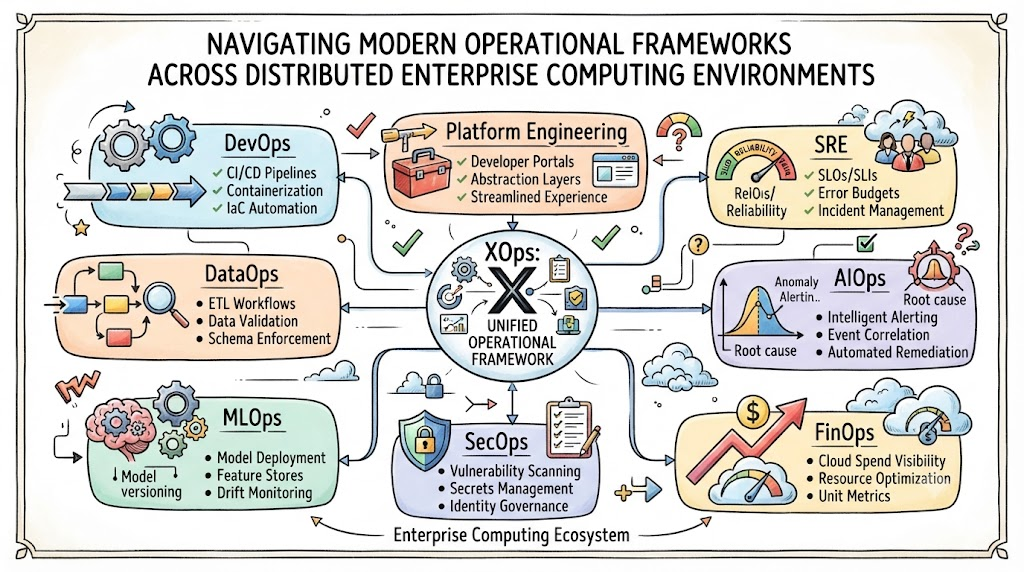
The operational paradigm XOps uses the letter “X” as a functional variable to encompass delivery, platform, data, security, and algorithmic automation disciplines within one overarching framework. Rather than permitting engineers to maintain separate operational islands, this unified philosophy links telemetry pipelines, declarative configurations, and release cadences into a coherent engineering lifecycle. Consider a real-time fraud analysis platform: developers release microservices via continuous pipelines, data specialists ingest continuous streaming inputs, machine learning engineers serve algorithmic models, and automated telemetry analyzers scan infrastructure health. Meanwhile, security engineers verify access controls, financial managers evaluate cloud expenses, and reliability engineers enforce availability targets. When these groups collaborate under a shared operational umbrella, they eliminate handoff friction, accelerate incident remediation, and ensure dependable system performance.
What Does XOps Include?
A mature operational environment unifies several specialized practices under one delivery model, ensuring continuous visibility and cross-domain stability across distributed systems.
| XOps Discipline | Primary Focus | Typical Responsibilities |
| DevOps | Continuous Delivery & Infrastructure | Automating deployment pipelines, standardizing containers, and maintaining declarative infrastructure. |
| DataOps | Pipeline Health & Ingestion | Orchestrating ETL workflows, monitoring schema changes, and safeguarding data quality. |
| MLOps | Model Lifecycles & Serving | Registering model artifacts, deploying inference engines, and tracking prediction drift. |
| AIOps | Algorithmic Telemetry & Alerting | Correlating event streams, filtering operational noise, and executing automated fixes. |
| SecOps | Threat Management & Compliance | Scanning build artifacts, managing secrets, and enforcing runtime access policies. |
| FinOps | Cloud Financial Governance | Monitoring resource spend, optimizing instance commitments, and managing cloud budgets. |
| SRE | Systems Reliability & Scaling | Establishing error budgets, managing incident protocols, and engineering resilience. |
| InfraOps | Core Systems & Hardware | Configuring underlying hypervisors, managing networks, and patching base operating systems. |
| Platform Engineering | Internal Developer Experience | Constructing self-service portals, defining golden paths, and streamlining build workflows. |
Every individual operational area reinforces the total architecture: platform specialists provide self-service tooling, site reliability engineers defend system availability, and data teams secure downstream analytical pipelines.
What Is XOpsSchool?
XOpsSchool operates as an educational knowledge repository designed to clarify the technical intersections within distributed enterprise ecosystems. The platform examines container orchestration, cloud-native administration, declarative automation, and modern deployment strategies alongside specialized data flows, machine learning lifecycles, and algorithmic incident correlation. By focusing on practical engineering blueprints and vendor-neutral architectural principles, the resource helps practitioners break through isolated domain barriers, build versatile skillsets, and design durable production infrastructures.
Why Is XOps Important?
Dynamic cloud ecosystems and distributed microservices steadily intensify the operational interdependencies across modern software platforms. When real-time streaming engines feed transactional data into distributed clusters, isolated operational methods inevitably break down. System outages regularly arise at the boundaries between specialized teams—such as sudden schema updates that break machine learning models or infrastructure expansions that inflate operating budgets. Adopting unified operational methodologies removes these organizational divides by standardizing infrastructure code, centralizing system telemetry, applying automated guardrails, and fostering shared technical ownership across the entire software ecosystem.
Why Choose XOps Training?
Pursuing comprehensive operational training broadens an engineer’s technical scope and unlocks deep architectural insights. Professionals who understand how container runtimes influence pipeline latency, how security checks impact continuous deployment speed, or how statistical drift alters system telemetry can design more dependable platforms. This diverse training produces versatile professionals who collaborate smoothly across development, platform, data, and management teams, systematically shrinking technical debt and accelerating incident triage.
How Does XOps Training Work in Practice?
A structured learning progression guides engineers through real-world implementation stages, moving methodically from foundational systems concepts to advanced automated workflows.
- Configuring Linux operating system internals, network protocols, system services, and shell scripts.
- Establishing version control workflows, automated branch testing, and continuous delivery pipelines.
- Building lightweight container images, optimizing build layers, and auditing container vulnerabilities.
- Deploying, configuring, and scaling application workloads across production Kubernetes clusters.
- Provisioning repeatable multi-cloud infrastructure declaratively through code and GitOps repositories.
- Instrumenting distributed microservices using unified tracing spans, runtime metrics, and log aggregation.
- Embedding dynamic vulnerability detection, policy-as-code guardrails, and automated secret rotation into deployment pipelines.
- Orchestrating reliable data transformations, monitoring model inference behavior, and correlating telemetry anomalies.
Targeted, scenario-driven laboratory exercises cultivate the practical troubleshooting instincts required to diagnose and resolve production failures swiftly.
XOps Certification: What Should You Look For?
Practitioners evaluating certification programs must seek out performance-based laboratory assessments instead of superficial theoretical tests. A credible qualification verifies that an engineer can configure declarative infrastructure, resolve broken deployments, analyze high-cardinality telemetry anomalies, and secure distributed communication channels. While passing an exam confirms that a candidate understands standard procedures and core platform capabilities, direct hands-on troubleshooting experience remains the true mark of engineering proficiency.
XOps Tools: Understanding the Technology Stack
Modern enterprise delivery pipelines leverage specialized tools across multiple technical domains, avoiding rigid single-vendor environments to maintain operational adaptability.
| Operational Area | Example Tools | Practical Purpose |
| Version Control & CI/CD | Git, GitHub Actions, GitLab CI, Jenkins | Tracking code changes and running automated test, build, and deployment pipelines. |
| Containers & Orchestration | Docker, Podman, Kubernetes, containerd | Packaging isolated dependencies and orchestrating resilient container runtimes. |
| Infrastructure as Code | Terraform, OpenTofu, Pulumi, Ansible | Provisioning cloud resources and maintaining declarative server configurations. |
| GitOps & Delivery | Argo CD, Flux CD, Spinnaker | Reconciling infrastructure environments directly with declarative Git repositories. |
| Observability & Metrics | Prometheus, Grafana, OpenTelemetry | Ingesting performance metrics, tracing requests, and visualizing operational health. |
| Log Management | Elasticsearch, Fluentd, Kibana, Splunk | Collecting, indexing, and analyzing structured system logs across multi-cloud environments. |
| AIOps & Remediation | Dynatrace, Datadog, BigPanda, Moogsoft | Correlating operational signals, suppressing alert fatigue, and accelerating root-cause analysis. |
| Secrets & Policy Control | HashiCorp Vault, Open Policy Agent, Kyverno | Managing dynamic encryption keys and enforcing programmatic cluster security policies. |
Selecting appropriate tooling requires a balanced evaluation of organizational constraints, compliance standards, and existing infrastructure investments.
DevOps Training as the Foundation of XOps
Establishing reliable DevOps practices provides the indispensable groundwork for every subsequent operational discipline. Mastering Git collaboration, infrastructure automation, container management, deployment strategies, and continuous integration pipelines gives engineers the foundational toolkit needed to handle advanced technical ecosystems. Without consistent delivery automation and immutable infrastructure, teams cannot reliably run complex downstream architectures like real-time streaming pipelines, automated model retraining, or self-healing platform topologies.
AIOps Training: Adding Intelligence to Operations
Algorithmic operations apply machine learning models, statistical scoring, and pattern recognition to digest millions of operational signals across distributed systems. By aggregating metrics, traces, and system logs, intelligent operational platforms identify anomalies, correlate events across interconnected services, filter out redundant alerts, and accelerate root-cause analysis. However, operational algorithms rely entirely on dependable telemetry; feeding unstandardized, fragmented, or noisy data into these engines generates misleading predictions, excessive false alarms, and unsafe automated interventions.
MLOps Training: Taking Machine Learning Into Production
Machine learning operations transfers experimental data science models into robust, enterprise-grade production services. Standard software development tracks source code and release artifacts, but machine learning deployments require the ongoing synchronization of code, fluctuating data sets, and evolving model weights. Comprehensive operational pipelines automate feature storage, manage model artifact registries, support canary deployments, and track real-time inference drift, empowering engineers to trigger automated retraining pipelines whenever incoming data profiles evolve.
DataOps Training: Making Data Operations Reliable
Data operations introduces continuous integration automation, agile workflows, and statistical monitoring to enterprise data processing pipelines. Within distributed microservice systems, an unannounced database schema update can silently corrupt analytical warehouses and disrupt live machine learning models. By building automated schema checks, pipeline tests, data lineage tracking, and continuous pipeline observability into workflows managed by tools like Apache Airflow or dbt, teams keep critical data flows dependable, auditable, and resilient.
Real-Life Scenarios / Experiences
Deploying cross-domain operational practices solves pressing architectural challenges across enterprise engineering platforms.
- A payment services platform eliminates transaction failures by deploying unified OpenTelemetry tracing across application services and database clusters, highlighting database query bottlenecks immediately.
- An online retail portal avoids sudden database exhaustion during seasonal traffic spikes by configuring automated load shedding alongside custom latency-driven autoscaling rules.
- A medical analytics organization catches data pipeline failures early by enforcing automated schema validation tests that instantly pause pipeline processing whenever incoming records miss expected formats.
- A consumer platform safeguards user recommendation accuracy by tracking model drift in real time, routing traffic back to a stable baseline algorithm whenever inference data diverges significantly.
These real-world implementations show how unified operational practices protect system availability, preserve business revenue, and maintain technical stability under demanding operational conditions.
Common Mistakes to Avoid When Choosing Learning Resources
Engineers must scrutinize instructional programs carefully to avoid curricula that provide minimal real-world engineering value.
- Selecting video-only courses that skip mandatory hands-on terminal laboratories.
- Relying on multiple-choice quizzes that fail to test practical troubleshooting skills.
- Focusing exclusively on one vendor’s proprietary tools rather than portable, open architectural standards.
- Learning automated scripting while skipping essential Linux networking, file systems, and system processes.
- Running labs solely on local machines while neglecting distributed cloud networking and access management.
- Skipping distributed tracing, custom metric collection, and structured log parsing to focus exclusively on basic deployments.
- Configuring infrastructure manually through web dashboards rather than using declarative Infrastructure as Code.
- Treating a course completion certificate as a substitute for real-world debugging and operational experience.
Avoiding these common educational pitfalls ensures that engineers invest their energy into developing authentic, production-ready capabilities.
How XOpsSchool Can Support the Learning Journey
Engineers looking to master modern operations can explore the structured guides provided by XOpsSchool. The platform delivers systematic technical documentation, step-by-step tutorials, and production blueprints covering Linux system administration, Kubernetes orchestration, Terraform automation, and GitOps pipelines, as well as DataOps validation workflows and MLOps deployment architectures. By prioritizing real-world operational patterns over surface-level theory, the resource provides an accessible roadmap for engineers who want to build, scale, and automate resilient cloud platforms.
How to Get the Most From an XOps Course
Learners gain the deepest expertise by following an active engineering cycle: Learn, Implement, Break, Troubleshoot, Document, Automate, and Measure. Consuming video lectures passively creates an illusion of mastery that collapses during live operational crises. True technical intuition grows when an engineer intentionally breaks a Kubernetes ingress configuration, isolates the fault using deep observability tooling, writes a concise post-mortem analysis, and writes automated configuration guardrails to prevent identical failures in the future.
Frequently Asked Questions
1. What core concept defines the modern XOps methodology?
The model functions as an umbrella framework that unites distinct operations disciplines—such as DevOps, DataOps, MLOps, and SecOps—under a cohesive architectural strategy. It uses the letter “X” as a functional variable, emphasizing automated deployments, shared telemetry fabrics, and structured collaboration across cross-functional technology teams.
2. How does the scope of XOps surpass traditional DevOps?
Traditional DevOps primarily bridges the gap between software development and platform operations for standard application delivery. The broader XOps methodology extends this foundation by incorporating data ingestion pipelines, production machine learning lifecycles, algorithmic operational insights, and cloud cost management into one unified delivery framework.
3. Which fundamental technical skills should a beginner master first?
Engineers should establish a rock-solid foundation in core Linux system administration, shell scripting, network topologies, and Git version control before exploring complex operational disciplines. Once practitioners master these fundamentals, they can learn containerization, cloud orchestration platforms, and automated continuous delivery pipelines with confidence.
4. Why does cross-domain operations require deep system observability?
Observability moves past simple monitoring dashboards by providing granular, actionable context across complex, distributed microservices through structured logs, distributed traces, and high-cardinality metrics. Without comprehensive observability fabrics, engineering teams cannot locate the root causes of subtle performance degradations across interconnected data, application, and cloud infrastructures.
5. How do algorithmic systems enhance enterprise IT operations?
Algorithmic operations platforms parse massive telemetry streams to suppress operational alert noise, correlate related events across disparate systems, and flag subtle performance anomalies. This intelligent processing helps operations teams identify root causes faster and execute automated self-healing scripts before service degradations impact end users.
6. Can an experienced software developer transition into an operations engineering role?
Software engineers bring valuable programming expertise, architectural insight, and development lifecycle experience directly into operational roles. By expanding their practical knowledge into declarative infrastructure automation, container orchestration, and continuous observability frameworks, developers can successfully pivot into modern platform engineering and site reliability roles.
7. Does earning a technical certification guarantee an enterprise engineering role?
Earning a technical certification proves that an engineer understands fundamental operational concepts and standard tooling features, but it does not guarantee a job. Technology organizations consistently value real-world problem-solving skills, hands-on production troubleshooting experience, and architectural competence above passive paper credentials.
8. What functional distinction separates DataOps from MLOps?
DataOps focuses on orchestrating, transforming, validating, and monitoring data pipelines to deliver clean, reliable data for business intelligence and analytics. MLOps builds on these reliable data streams, managing model artifact versioning, validation pipelines, deployment rollouts, and continuous performance tracking for machine learning models.
9. Why do modern operations teams rely on Infrastructure as Code?
Infrastructure as Code allows teams to define, deploy, and update cloud resources using auditable, declarative text files instead of manual dashboard adjustments. This practice prevents configuration drift, ensures complete environment parity across deployment stages, and integrates infrastructure adjustments directly into standard Git review workflows.
10. How does GitOps streamline operational deployment workflows?
GitOps designates Git repositories as the definitive source of truth for both application states and infrastructure configurations. Automated platform controllers continuously reconcile live environments against the stored repository declarations, accelerating release cycles, simplifying rollbacks, and providing an immutable audit trail for every change.
11. Must an operations engineer learn Kubernetes to succeed?
Although alternative orchestration engines exist, Kubernetes serves as the standard control plane across modern hybrid and multi-cloud enterprise platforms. Mastering container orchestration principles, pod networking, storage management, and cluster reliability remains an indispensable skill for any engineer who operates modern distributed infrastructure.
12. How does continuous security automation strengthen deployment pipelines?
Integrating automated security checks into build and release pipelines embeds static code scans, container image vulnerability checks, credential rotation, and policy-as-code guardrails directly into everyday delivery cycles. This proactive posture intercepts critical security risks early without impeding the organization’s software release speed.
Conclusion
The swift rise of multi-cloud architectures, algorithmic telemetry platforms, and complex data streams demands an end to isolated engineering silos. By adopting unified operational methodologies, forward-looking organizations integrate core infrastructure management, dependable delivery pipelines, strict data quality controls, and predictive incident remediation into an integrated technical continuum. Cultivating these versatile skills enables engineering teams to construct fault-tolerant, self-healing platforms that scale securely under demanding enterprise workloads. Technology professionals who embrace end-to-end operational visibility, declarative automation, and cross-functional systems integration will lead the future of resilient software engineering.
Leave a Reply